A Star Wars movie marathon in an hour and a half?!
You better believe it, kid. Charles Ross is Luke Skywalker in: One Man Star Wars Trilogy.
Last week I had the privilege of seeing Charles Ross' One Man Star Wars Trilogy at Brisbane's Cremorne Theatre, in the Queensland Performing Arts Centre. The curtains opened, and there was Charles dressed in black, zooming around the stage. He proudly trumpeted the 20th Century Fox Fanfare and then the Star Wars Theme. What first impressed me was Ross' attention to detail. He didn't indulge in needless geek-isms (though he probably could have) like rattling off the receding prologue, rather he only used those elements most pertinent to the plot and the comedy. In this instance he used the suggestion of an opening crawl to underscore the comedy. Indeed, a great deal of the laughs were sourced from his clever gestural comedy: any Star Wars fan could tell when he was an X-Wing, a TIE Fighter, or Jabba the Hutt. His impression of a fallen Imperial Walker is absolutely priceless.
Charles Ross' delivery was spot-on. It's almost as if George Lucas was backstage the entire time, egging him on: "faster, more intense!" His Luke Skywalker was an exceptionally fast-talking, whiny farmboy, and kept the plot moving at a brisk pace. Clocking in the entire Trilogy at one and a half hours is no mean feat for one actor, and frankly I'm surprised he still had breath in him by the end. That's probably the most impressive part of the show; that one man can supply enough energy on-stage (with no props, mind you) to conjure an entire universe in the collective mind of his audience.
His sound effects were brilliantly replicated, from the screaming TIE Fighters to R2D2's bleeps and croaks. While he rarely deviated from his regular vocal timbre, his meticulous phrasing and pacing perfectly encapsulated each character. His most notable characterisations included Jabba the Hutt, Yoda, and my personal favourite, the Emperor. Ross' sketches were almost satirical, poking fun at Hamill's [and McDiarmid's] over-acting, and inconsistencies between the movies, but always with love and respect for the source material. Think of it as a playful jab in the ribs to a close friend. Surprisingly, prequel ridicule was kept to a minimum, but as Lord Vader said, it'd be all too easy to traverse that well-worn road.

Charles Ross is Master Yoda in: One Man Star Wars Trilogy.
In many ways, Charles Ross' performance highlighted the failure of Jar-Jar Binks as comedic relief. While in the Original Trilogy, comedic duties were shared by the entire cast and weaved into the story, the Prequel Trilogy attempted to project all of its comedy onto one character, and as a result, poor Jar-Jar stood out like a sore thumb in an overly serious universe. Here Charles is simply fleshing out what is already there; a comedy goldmine of science fantasy. He seemed to have the most fun with Return of the Jedi, like a child playing with his Ewok figurines. In this act he threw in more asides than usual, and really enjoyed hamming it up as Emperor Palpatine.
The most interesting thing to me was what he chose to keep and what he chose to leave out. One thing's for certain, he always chose the scenes and dialogue that were a) most important to the plot's momentum, and b) rich with comedic potential. Ross often avoided more obvious gags to highlight dynamics of the films that I hadn't even thought of (and I've seen the films many, many times). His familiarity with the films and the script was apparent to everyone in the audience - he probably could have rattled off the entire thing - right down to the musical cues, transitions and scene cuts, which he also humorously enacted.
At the conclusion of Return of the Jedi, Charles took the time to have a chat with the audience about the show's history, and how he came to tour the world doing what he loves. He really is a very endearing character in and of himself. All in all, the One Man Star Wars Trilogy gave nothing of the impression of a geek's self-indulgent dream, and everything of a seasoned actor and comedian's finely crafted stage play. If you ever wanted to watch all three movies in a row, save yourself some time and see Charles Ross. He packs all of the magic of Star Wars into one and a half hours, and plenty of laughs as well. I highly recommend this show to any Star Wars fan, or anyone with an appreciation of the films. If on the off-chance you're unfamiliar with that galaxy far, far away, rent them out then go see this show!
Charles Ross closed with the announcement that his next show will be the 'One Man Lord of the Rings Trilogy'. I for one can't wait to see it.
I could spend an entire blog post arguing the merits of Wii Sports as the Wii's best game, but I won't.

Best. Game. Ever.
crazed_ninty_fanboi3000 posted:
"OMFG WTF?! Did teh_red_baron just say Wii Sports is teh best Wii gamez?! LAFF! 'Sif!"
In many ways, it is. From the point of view that its motion controls are unparalleled on the Wii thus far; it's accessible to almost anybody due to its intuitive control; it sells systems; and it is a compendium of pure, unadulterated fun.
With the release of Pro Evolution Soccer 2008 and its subsequent praise from IGN, it struck me that despite Wii Sports' clear demonstration of the Wii's control possibilities and its sporting chops, we are yet to see a sporting title, nay, a title proper that rivals its IR implementation and motion control. The Wii has tennis games, bowling games, and boxing games in their own right, and yet none of them come close to matching the precision control or feel of any one segment of Wii Sports.
That to me is a disgrace, but it all comes back to one central issue: developers don't know how to implement IR and motion controls.
Look at the finest examples of Wii controls: Wii Sports, WarioWare, and Metroid Prime 3. They're all first party Nintendo titles. I think the onus is on Nintendo to encourage the effective use of the Wii's control possibilities - it's supposed to be the defining aspect of the console, and they're allowing it to be passed over.

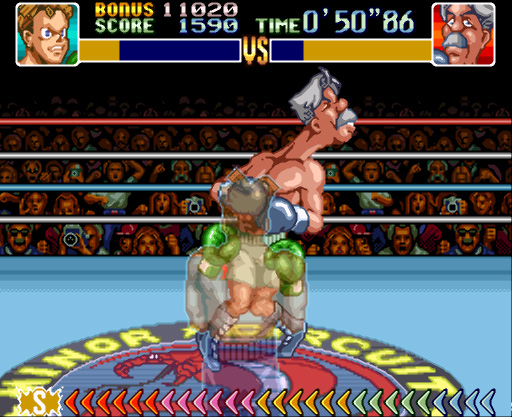
Disrespect for the elderly? More please!
Is Wii Sports as good as it gets? Are you excited about the future of sporting on Wii? Who's doing it right and who needs to get their act together?
I was reading an article on the Ten Trends in videogames over the last decade and it got me thinking. More specifically, it got me thinking about which trends are or have been generally bad for gaming over the last decade. Here goes:
Square pegs jammed into round holes.
Castlevania. Sonic the Hedgehog. Some games were never meant to be played in three dimensions, and those are just a few examples. We've witnessed a lot of 2D-to-3D transitions over the years; some glamorous (Prince of Persia, Mario, Ninja Gaiden, Metroid Prime) and others not-so-glamorous (Street Fighter EX and the above), but these transitions should never have been forced. 'The Death of the Platformer' has been bandied about a lot recently, but is this really the case, or are there just a lot of square pegs being jammed into round holes? Bionic Commando: ReArmed is a promising step in the right direction, and I am keen to see many glorious returns to 2D or at least 2.5D in future (please, Sonic, PLEASE!).
Violent games vs. Games-with-violence.
Games like Manhunt 2 and Kane & Lynch should really never be made. Not only are they bad for the image of the industry, they're more style than substance. Games like this are developed purely for the controversy, with gameplay tacked on. If it furthers the plot, then fine (obviously you can't play GTA without stealing cars), but don't try to tell me that a game like Manhunt is 'mature'. They're just going to get all the good games with violence banned.
A class-based gaming society.
Don't worry, I'm not going to launch into a Marxist dialectic, but I find the sale of multiple models of the same console to be utterly ridiculous and short-sighted from both a consumer point of view and a marketing point of view. The market may decide this one already (is it any coincidence that the console with only one model is outselling all others?), as Sony seems to have scrapped all other PS3 SKUs in favour of the 40GB model. Microsoft seems to be constantly re-jigging their X360 SKUs, possibly at the risk of further consumer confusion. Is it now the Arcade, Pro, and Elite models? More than one model means more than one price point, and judging by the Wii's performance this last year, this is the most important consideration for consumers. Developers are also in the dark on this - should they account for a hard-drive or not when developing for the 360?
Throwing the baby out with the bathwater.
It seems these days that offline multiplayer has been completely neglected in favour of online. Anyone who's played system link Halo at a friend's place knows that this is a glaring oversight. Two-player split-screen in an FPS is not good enough. Online multiplayer is great, but we still need to play with our friends on the couch. System link and 4-player should be an industry standard for all multiplayer games by now. Make it happen.
Square peg in a round hole: MKII.
Tacking on multiplayer for a single player experience and vice versa is a waste of development time. Metroid Prime didn't need multiplayer - thankfully it is still a great game, but to think that that time could possibly have been used to put more into an already great game, is tragic. I'm sure a lot of FPSs could have also benefited from not having a single player mode as well, instead of having to deal with the pretense of having one. Ultimately, there are chiefly single player experiences and chiefly multiplayer experiences; they should be developed and marketed as such. The lies must end!
And that's all from me for now.