Showing posts with label Reviews. Show all posts

13 October 2011

Knytt Stories: Dream Weaver


Knytt Stories is perhaps the most beautiful game I've ever played.  There's nothing flashy about it, but its beauty, both in atmosphere and gameplay, lies in its simplicity.

Its command of form and colour is second to none, evoking curiosity and wonder at every turn.  Every screen is earmarked by little intricacies - birds, insects, snowfall, and glistening crystals - forming the impression of a living, breathing world that exists even when the player isn't there.

By its creator's own admission, there's nothing particularly original about Knytt Stories - it's essentially a Metroid clone in design - but it distills each element into its purest form.  Like Metroid, the game is set in a foreign land and fosters that sense of isolation and "other-ness".


Again like Metroid, the entire game is one large "circuit breaker" puzzle.  The game world consists of a single sprawling level, which opens up as the player gains new skills.  Most platformers use items as breadcrumbs to encourage player exploration.  The only items in Knytt Stories are significant and skill-expanding - the floating jump, the double-jump, the hologram - and yet they are merely tools for further exploration.  Beauty is the sole motivator for progression and the reward is getting to see more of that beauty.

Knytt Stories is so confident in this design that it refuses to fall back on combat; not as a motivator, not as a solution to problems.  This is in-keeping with the game's story: the game world is corrupted by a strange machine, so if a creature attacks you, it's only because its nature has been corrupted by the machine.  Violence clearly doesn't solve anything in this scenario, and so evasion becomes a key maneuver in the game, aided by clever item use.  The umbrella, for instance, can be used to glide across ravines, but it can also be used to shelter the player from falling projectiles.  This keeps the focus firmly on pure platforming.


There's no separation between areas of the game, no loading times, nothing to disturb the flow of play.  Save portals are inconspicuously built into the floor (preventing distraction), and littered conveniently throughout the environment (preventing frustration).  The player need only tap the 'down' button while running past and the game is saved without so much as a menu or pop-up.  Knytt Stories is a one hit, one kill affair, which goes hand in hand with its efficient design.  If you don't have combat, you don't need to stand around getting killed, you don't need a health gauge, and you don't need to kleptomaniacally collect doodads to refill health or ammunition.  First person games have been moving towards this efficiency for years now - regenerative health takes at least one element of item collection out of the equation - but few if any have been brave enough to go the whole hog (even Mirror's Edge chickened out to its own detriment).  If you do die in Knytt Stories (and you will, often), the player immediately respawns at their last save portal, which is never far away.  In this way, the flow of the game is never placed in jeopardy.

The sound design of Knytt Stories stays true to its mantra of beauty in simplicity.  The ambient noises of waterfalls and singing birds punctuates the constant rhythm laid down by the protagonist's footsteps.  The sparseness of these sounds creates a nice envelope for the music when it bubbles to the surface.  The soundtrack runs the gamut of Eno-like ambiance during to apocalyptic techno, emerging only to mark set-pieces of awe and dread.


Knytt Stories is a breath-taking game that filled me with awe.  What I found amazing was the efficiency and restraint it took to produce this effect.  By trimming the fat, Nifflas cut straight to the heart of what made Metroid so great in the first place.  The result is a game dripping with atmosphere that plays as smooth as silk.


Knytt Stories is a freeware game for the PC, developed and designed by Nifflas.  Nifflas' games are available for download and for purchase on his website.

08 October 2011

What's Stuck in Jack's Craw?


Jack Claw is a top-down action scroller built around an interesting mechanic: Jack's Claw.  The Claw is a Doc Ock-like tentacle protruding from the protagonist's right arm that can be used to grip, lift, smash, crush, and throw just about anything.  Unfortunately, the core mechanic falls down in execution.  The mouse controls for The Claw simply aren't sensitive enough to forcefully smash or throw anything.  The result is a very calm and considered Claw, too slow to have any fun with: the fun of wrecking things, slamming cars from wall to wall, throwing guys at high velocity into faraway dumpsters.  With all the physics and destructable environments firmly in place, it really is a missed opportunity.  Frozenbyte can attest to this, as they were forced to abandon the project to save the company's future.

Presentationally, the game is quite strong, if not a little cliché.  Jack has broken out of jail, on the run from the authorities in a rundown town.  The setup draws heavily on the comic book stylings of Sin City, from the [captioned] opening monologues to the 40s-era décor.  There's a hint of Tarantino in there as well, with Bombora-esque surf rock undercutting it.

At this point Jack Claw consists of only one level, and can be finished in under five minutes, so it's better that you go in thinking of it more as a prototype than a full game.  Having said that, the game does come with a level editor, so perhaps the story doesn't end here.


Jack Claw is a computer game developed by Frozenbyte.  You can download it as part of the Humble Frozenbyte Bundle.   You can also take part in the game's future on the Frozenbyte forums.

04 October 2011

Glitch


Glitch is the logical lovechild of Tiny Speck (the makers of Flickr) and Keita Takahashi (the maker of Katamari Damacy), but I must confess, I'm not entirely certain how to take it.  It definitely feels like a new breed of game; a strange hybrid between Blueberry Garden and a social network.

As someone who has been brought up on games, I felt that Glitch coddled me too much in its opening moments.  I wanted to explore this strange new world for myself, and work out how it ticks.  Nonetheless, I appreciate that I am probably not Glitch's target audience.  Once all the tutorialising is out of the way, the game does evoke a living, breathing world, ever changed by its inhabitants.  In fact, Glitch offers precisely eleven worlds to explore, each of which resides within the particularly imaginative mind of a giant.  Players interact with most objects and creatures in the game, and some actions have a tangible and lasting effect on the game's environments.  Players can interact with each other as well, and while the feeling of community really contributes to that sense of a living, breathing world, some of the social networking elements honestly feel like a distraction to the game itself.  I take my hat off to whoever can manage to multi-task these seemingly disparate elements.

There are energy and mood levels to attend to as well, which again feel like a distraction - an unnecessary game-y element - to the game's explorative core.  It didn't take me long to fill my inventory with food items (designed to increase my energy and mood levels) but I never seemed to need them.  Your avatar has experience levels as well, which at least gives you something to shoot for.

In a way, Glitch lacks confidence in the attractiveness of its core gameplay, and I don't think it should.  I would love to see the game shed its unnecessary game conventions and social networking elements to put the spotlight back on the fresh and the new.  The prospect of building and shaping an imaginary future with other players is something too compelling to pass up.


Glitch is a web-based massively multiplayer online game designed by Tiny Speck and Keita Takahashi.  Sign up here to play the game (there is a waiting list).

29 September 2011

Castaway: No Frills Thrills


Castaway Island TD is nothing fancy, in fact it's pretty much a by-the-numbers tower defence game.

As you may have guessed, the player assumes the role of a wide-eyed boy, stranded on a desert island.  Despite it not being his home, the boy has been asked by some kind of spirit to defend this island from invading monsters.  Actually it would have been more appropriate to call this game Castaway Archipelago, as the boy must defend a series of different islands throughout the game.  The player must defend the island with his highly improvisory woodwork skills, converting coconut palms into armed towers.  Inexplicably, these towers cost money to build.  Also inexplicably, the monsters dispense coins (and gems) when slain.  Apparently money does make the world go round, even on a desert island.

Vanquished monsters also drop gems which can be used to augment towers with elemental powers (fire, ice, lightning, et cetera).  The Spirit of the Island often grants new traps to the player as a reward for clearing levels.  Clearing a level entails enduring six waves of attack with the island's mystical crystal intact.

Presentationally, you'll find many more compelling contrivances for tower defence in games like Plants vs. Zombies and Ninjatown, but there is a surprising amount of polish applied when it comes to the game's interface and feel.  In my opinion, Castaway Island is a much smoother experience than Ninjatown.  When you consider the fact that Ninjatown is a full-priced DS title, and Castaway Island is a free, Flash-based game, this feat becomes that much more impressive.  There's a surprising amount of content on offer here as well, and a save feature for those with a login.

It may not be original; it may not dethrone Plants vs. Zombies, but it's hard to go past a free tower defence game that outplays some full-priced games.


Castaway Island TD is a free Flash-based game by Armor Games.  You can play the game here.

27 September 2011

Pale


Pale is a strange little exploration game.  It drops the player in pitch blackness, save for a red diamond in the distance.  Using the W-A-S-D keys to move and the mouse to look around, I started to gain an appreciation of my position/distance in relation to the red diamond.  Dropping a 'flare' of sorts with the 'F' key (actually, I dropped many, many flares) added another dimension - height - such that I could see the labyrinthine walls envelop me.

By far the strangest aspect of the title is the movement.  The player can only move towards the red diamond by walking backwards into it.  And so the player must maintain awareness of his position relative to the light and space around him to advance.  The diamond 'sings' with blue light upon contact, and then it's time to search for the next one.  It's a very interesting idea that challenges the obvious-ness of goals and visuals in other games.

It doesn't set the earth on fire, but it presents an interesting mechanic wrapped in an interesting idea.  I would definitely recommend tinkering with it for a few minutes.


Pale is a free Unity-based web game, designed and developed by André Berlemont and Brice Roy of One Life Remains.  You can play the game here.

03 October 2010

Sega Rally: Arcade Perfect.

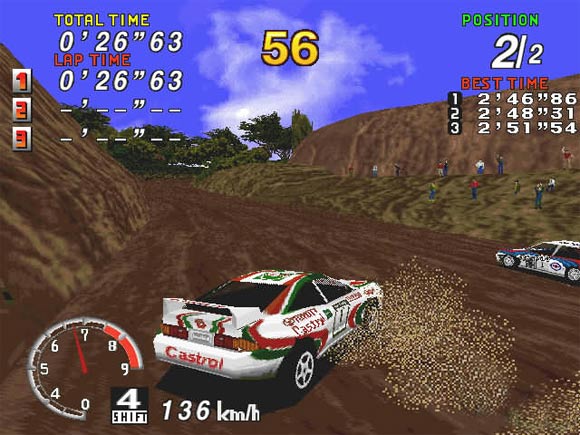
Celica on Desert


Back in the 32-Bit era, arcade perfection was the Holy Grail of game development. It was the question on everybody's lips: "yeah yeah yeah, that's great, but tell me - is it arcade perfect?" It's a strange term looking back, now that consoles have spread their wings and arcades the world over die a slow and painful death, but 'arcade perfect' was once the highest praise you could lavish on a home conversion. I'd say we've come a long way since then, but by demanding more than mere perfection (and getting it), we've eroded away the canal that birthed games like Sega Rally. Sega Rally Championship for the Sega Saturn is arcade perfect. But it's more than that - it's just plain perfect. Some may find this hard to believe approaching it retrospectively - sure, polygon counts and texture maps have improved since then - but mark my words, no rally game since has even touched its handling or track design.
Lancia Stratos on Lakeside
Sega Rally is the poster child for "quality over quantity", sporting only three tracks (Desert, Forest, Mountain - four if you include the secret Lakeside track) and two vehicles (a sixth generation Toyota Celica, and a Lancia Delta HF Integrale - three if you include the secret Lancia Stratos). The Desert track is the shortest and simplest of the three, giving the player a taste of turns to come, and offering insights into the very different but equally viable behaviours of its two main characters: the long-horned Celica that throws its weight into corners and gains on straights, and the tight-turning Tom Thumb wonder that is the Delta. And yet the Desert has a flavour all its own, of salient jumps and short, sharp chicanes. The Forest track is all business until it reaches its centrepiece, the hairpin right, putting you through the ringer all the way to the checkered flag. And the Mountain track is as wild as a bucking bronco, offering very little reprieve for the unfocused rider.
Delta on Mountain

Today's game players would baulk at such a limited selection, but I defy them to find three more expertly crafted tracks in any rally game (or indeed, any racing game), or two cars to race on them that ever felt this right. This is not nostalgia talking here - this is the same Sega Rally that kept my housemate and I up nights last week. It's a rare treat to have two equally matched Sega Rally players under the same roof, but that is what we have at my house. The thrill of waiting for your opponent to slip, and power-sliding past him to the finish line; the satisfaction of licking the wall on a perfectly executed hairpin turn; the friction of tyres to asphalt, to gravel, to mud; the superbly balanced handling; these are sensations I could never adequately describe or replicate.
Delta on Forest


So here's to you, Sega Rally, King of Rally Racing. Don't ever change.

26 May 2010

Monkeying Around: A Monkey Kong Review.


Developed by Mike Meyer for the PC.

Monkey Kong is a platformer endearing in its simplicity. The levels, composed entirely out of blocks and girders are intentionally reminiscent of Donkey Kong, as is the game’s protagonist primate. Monkey Kong’s mission is not dissimilar from that of many monkeys: to get the bananas. There is no player death – no deathtraps, enemies, or rolling barrels to navigate – and that’s kind of the point. As game creator Mike Meyer states on his website, “there’s no winning or losing, just platforming around.” Everything about the game speaks to this playfulness of ‘monkeying around’, from its impressive 8-Bit rendition of Tenacious D’s “Tribute”, to the comical backflip that is so integral to the monkey’s move set. And while we’re on the subject, Monkey’s controls feel just right: not too slippery, and not too tight. The screen is presented in the window of an arcade cabinet, contextualising the game as a quick, good time. And it is: there are only a handful of levels to get through at random, and once you’ve nailed the backflip mechanic it’s smooth sailing. After all, the game was developed within a very short time frame for a competition, and is presented more as an idea of platforming than anything else. And on that level, it succeeds. Given its subject matter, Monkey Kong is a surprisingly elegant platformer. You could do far worse with your lunch hour.

Score:
 (out of four)

Click here to play Monkey Kong.

"Cloverfield is grassroots Godzilla."


Written by Drew Goddard, directed by Matt Reeves.

Cloverfield is grassroots Godzilla – a monster movie utterly determined to preserve its human perspective on disaster. The film achieves this chiefly through the use of handycam-style photography, presenting the ’story’ as a Reality-Show-Gone-Wrong as opposed to Epic Disaster Movie. I say ’story’ in inverted commas because it doesn’t feel like something somebody’s made up; rather it feels like something terrible just happens to unfold as someone is making a home video. The entire film is framed in this light – at no point do we see what the character behind the camera does not see - and it is this consistency that makes it seem so authentic.

Cloverfield cleverly opens with a surprise farewell party, and it is at this party that we are able to drink in the characters, their personalities, their relationships, and their motivations. By the time disaster struck, I was already invested in the characters and their drama. In particular, I felt a deep connection to ‘Hud’, the film’s fictional photographer. In many ways, he is the main character – the lens through which we perceive the group’s travails, the voice that guides us through the rubble and trauma – even though he’s the one we see the least. I wondered whether the name ‘Hud’ was an intentional play on the term ‘HUD’ or ‘heads-up display’, given to describe his role as framer and interpreter...

Cloverfield anchors its humanity, firstly through the believable performances of its ensemble cast. Each character faces loss and trauma (physical and mental) in uniquely valid ways. (This is best exemplified when protagonist Rob receives a call from his mother. How do you break the news that someone very close to you has died? What do you say to a friend who has just lost a loved one, when you’ve really got to keep moving just to survive?) And secondly, through Matt Reeves’ stubborn refusal to show the creature in its entirety until the final act. At no point is it allowed to steal the focus – it is an immovable force of nature – only when the beast poses a direct threat to the group do we finally see it in full.

The destruction of Manhattan is earmarked with several powerful moments, the first of which is the severed head of the Statue of Liberty wiping out a city street. How many Hollywood blockbusters has this magnificent structure survived? Even Planet of the Apes spared Lady Liberty! It took someone with the gall to destroy her to instill that tangible sense of hopelessness. From that point on, I couldn’t shake the feeling that Cloverfield was more than just another disaster/monster movie. Without spoiling anything, the most powerful moment comes at the very end, when we catch a glimpse of the video that these events were accidentally taped over (this was alluded to by Rob during the opening party scene, and throughout the ‘recording’ one can see snippets of this video interspliced with the disaster footage) – of a date on Coney Island, no less. It becomes a point of reference for these characters whose journeys we’ve shared – how traumatic events can shape and change people, how they can redefine their relationships.

By focusing on what is real – that is, people and their reactions to personal loss – writer Drew Goddard and director Matt Reeves have crafted a thoroughly believable work of fiction. And though I keep telling myself that all this can be found in a monster movie, I can’t help but disbelieve it.

Score:

 (out of four)

20 February 2010

Cream Wolf: Flash-based Fever Dream.


Cream Wolf is a fever dream in Flash form.

Concretely, Cream Wolf is about an ice cream vendor and werewolf who gobbles up his clients by night. It proves to be a strange and interesting premise for a game that is eerily familiar, yet alien and unsettling. Goofy 8-Bit graphics and an off-kilter MIDI ice cream truck music are merely a veneer for this game’s black heart. By contrast, its gameplay systems are surprisingly complex, again throwing player expectations off-guard. Your avatar prowls the suburban streets in his little white van, playing Jack-in-the-box tunes to attract new customers. Collecting cones for speed and supplies, and holding ‘X’ to roll that siren song, the player must avoid other vehicles (because ‘they just wouldn’t understand’) while delivering iced confectionery to sweet-toothed children. Each order triggers a roulette-style mini-game, where the player must craft a specific ice cream creation quickly and accurately for reward. The reward? Fatter, meatier children, more susceptible to “Greensleeves” than ever before. As dusk sets in, your vision blurs, and it’s time to gather up the little blighters before the curse takes hold.

As the fat pre-teens – like rats – marched hypnotically towards my humble abode, an unmistakable wave of feeling washed over me: this is wrong. And then, with a blood-chilling howl, I eviscerated my prey, painting the lawns with the blood of children. Indie developers, take note – it is possible to disturb and entertain at the same time!

Score: (out of four)

Click here to play Cream Wolf.

25 January 2010

Raggamuffin Festival 2010: Lauryn Hill, Shaggy, Julian Marley, Sean Kingston & Steel Pulse Reviewed!


Saturday 30th January, 2010 at the Brisbane Riverstage, Australia.

Dreadlocks and weed smoke were the order of the day at the Brisbane Riverstage this January. Indeed, it was in surplus, or at least that’s the tale the Glad-bag full of joints on the ground outside told. Never have I witnessed a festival queue this long at this venue, not even for The Hives, Franz Ferdinand, or Nick Cave. And yet, for all the joints being passed around, I can’t imagine the bag-checking was terribly thorough. It seemed to be an unwritten rule – police presence was minimal if not non-existent – and security cracked down on fold-out chairs while developing convenient black spots in their vision in the shape of hand-rolled blunts. And why would you, I suppose; it kept the masses subdued enough not to cause any real trouble.

Unfortunately, I missed festival openers House of Shem due to the shambolic queuing system. I can at least say that their music sounded studio quality, as I was under the false impression that the music coming from the loudspeakers was being played from a compact disc.

When I finally entered the festival grounds, I wondered what perverted brand of justice would allow me to miss a talented band and not the infernal scribbling of Sean Kingston that followed. I don’t have much to say on the subject, actually – fans of Mr. Kingston would have been better off staying at home and listening to the CD – he was essentially standing on stage performing karaoke to his own tunes. Truly awful.

Thank God redemption was at hand, though, when Steel Pulse took to the stage. They sported a powerful reggae groove throughout the set, emphasising the bass line as all good reggae should. And while said grooves sat back in the saddle (again, as all good reggae should), the band played with a tightness that can only come from 35 years of musicianship.


Building on this strong musicianship came Melbourne-based blues and roots band Blue King Brown. Their set was as rhythmic as it was politically and emotionally charged. A great deal of that came from Haitian-born backing vocalist Ngaiire on the back of their tragic loss, but the stage well and truly belonged to lead singer and guitarist Natalie Pa’apa’a, loaded as she was with fire and charisma. This is strong message music at its finest – though perhaps a little too strong – I almost felt bad dancing to it, as if I was somehow trivialising its meaning by enjoying it aesthetically. I’m sure Pa’apa’a would be pleased to know this – mission accomplished!

Julian Marley, one of Bob’s many sons, followed to take things down a peg (or ’simmer down’, if you will). From a distance, I could have sworn it was the Man himself. Closing my eyes, I believed he was there. Unfortunately for Julian and his siblings, they will forever live in his father’s shadow. And how could you not, really – but there is still a degree to which they’ve failed to build on their father’s music – musically, politically, and spiritually. He looks like Bob, he sounds like Bob, but he doesn’t stir like Bob. Nonetheless, it remains a great privilege to be able to hear a Wailers tune sung by a Marley in this day and age.

Sly and Robbie came up as the sun went down, and the people danced into the night to their laundry list of riddims, each folding seamlessly into the next. Much as I revere them as pioneers and innovators of the Jamaican music scene, I found myself unable to penetrate their sound. It seemed so lost and unfocused, a reggae take on a Grateful Dead acid jam. But that’s some people’s bag, and I respect that.


Next came the one we were all waiting for (contrary to what Shaggy would have you believe) – Ms. Lauryn Hill – and by God, she’s still got it. I was truly astonished at how many devoted fans she still has even today, and in Australia no less. Their devotion was well deserved: Ms. Hill delivered a truly incendiary performance, spitting out lyrics like machine-gun fire. Set highlights included “Ready or Not” and “Doo Wop (That Thing)”. Julian Marley returned to the stage to perform a stunning duet of “Turn Your Lights Down Low”. The only down side was the annoying deejay, who was louder in the mix than even Hill, repeatedly yelling “come on Brisbane, make some nooo-oise!!” between each track. (Everyone could tell Lauryn hated him as well, which only added to our affinity.)

Shaggy closed the festival along similar lines (to the deejay, not Hill herself), under the false impression that everyone had come to see him. He seemed not at all impressed with the Brisbane crowd’s tired enthusiasm, despite the fact that it was 11pm and half of them were stoned out of their minds (some perhaps passively). It was a classic case of mismatched demographics: Shaggy was the drawcard to bring in a wider audience (mostly women who want to sleep with him for reasons unknown even to them), while reggae enthusiasts regard his music as Reggae Lite – watered down for the Great Unwashed. Strip reggae of all its political and spiritual significance, and what are you left with? A ‘rude boy’, and just a ‘rude boy’. Indeed, as I watched Shaggy (and Rayvon) amuse with his sexually-charged stagecraft, I found myself wanting for the stuff of substance: your Steel Pulses, your Blue King Browns, and your Lauryn Hills.

Wyclef Jean was originally billed to headline the show, but postponed his performance to 2011 to help the relief effort in his homeland of Haiti. It left me wondering – was Lauryn called in as a last-minute favour for an old friend? Or did she come out of hiding for the one opportunity she was guaranteed not to bump into her former lover and bandmate? Part of me hoped for a Fugees reunion, however unlikely that may have been. Nonetheless, I came away from Raggamuffin far from disappointed.

10 April 2009

We Are All of Us Living in the Shadow of the Colossus.

It's rather strange, the timing of the Shadow of the Colossus movie announcement. I had just rented and finished the game a week prior - you know, because it's FREAKIN' IMPOSSIBLE TO FIND, EVEN IN RETAIL STORES THAT STILL HAVE MORE SHELF SPACE DEVOTED TO PS2 THAN THE WII AND XBOX 360 COMBINED AND RIP-OFF MERCHANTS ARE STILL FLOGGING OFF USED PAL COPIES OF THE GAME FOR $90+ ON eBAY - when I saw it sitting on the shelf at my local Video Ezy as a weekly rental, I thought to myself, of course! The answer's so obvious, right under my nose all this time!


Shadow of the Colossus: bankrupting nerds since 2005.

I was under the pump, though, from the moment I rented it. I had only one week to suck the marrow out of an experience that has been upheld as one of two examples of 'videogames as art' in response to Roger Ebert's highly flammable assertions to the contrary last year. (And while we're still here, I agree with the game's 'art' status.) And I had to borrow my girlfriend's pink Playstation 2 [playing games on a pink Playstation can lend them a special kind of irony, especially if they're loaded with machismo like God of War]. If I can make a recommendation to those who have not yet travelled this road: for the full Shadow of the Colossus experience, try renting it for two or three weeks if you can. I only *just* made it on a 9 to 5, with a sick day, and I regret having to rush through the game just to finish it before return time.

(At first I tried to pace myself, trying to defeat two or three colossi per night, under the false assumption that there would be twelve colossi - like the number of signs in the zodiac, or the number of months in a year, or the number of disciples in Christ's flock - it's just a number that makes sense. But once I found out there were sixteen, I had to ramp up my efforts to four per night. It's from that point of view that they probably could have culled a further few colossi from the thirty they reportedly started with. Having said that, you don't want the game to end when it does, meaning that it hasn't overstayed its welcome, and it's just long enough to make you want more.)

(That's why I take serious issue with the whiney 13 year olds that complain about 10 to 14 hour videogames being too short, and videogame critics marking games down for it - 10 to 14 hours is the perfect length for a videogame. Those of us with day jobs don't have 40 to 60 hours to burn on one videogame; we're premium players. We want 40 to 60 hours brought to the boil and distilled into 10 to 14 hours of AWESOME.)

And that's the first cool thing I want to mention about the game: the core experience can be completed in around 10 to 14 hours, but you can lose yourself in its world for heaps longer if you choose. And if it was more than a weekly rental, I would choose. But given I had only the one week, I'll try to stick to discussing the core experience.

It's as if Team ICO went down to the pub (that same pub at the end of all worlds that Platinum Games went to when they came up with MadWorld), and their leader clasps his hands together and he says, "right, let's make a game that combines all the coolest things about videogames: platforming and end-of-level bosses. Except, instead of end-of-level bosses, let's make level bosses." Then everyone stares blankly at their boldest and brightest. "Oh, don't make me bang you over the head with it. The bosses are the levels. They're giants - colossi, if you will - and you must climb them to bring them down." And then they went back to the office and made it.


GTA-radar, eat your heart out.

I won't gloss it over for you, though - the development process wasn't without its hurdles. They wanted to make an overworld that was expansive and ancient - that seemed full of ancient stories, with footprints of heroes and beasts that came before, and they wanted the colossi to feel like an ancient part of that landscape - but they didn't want the players to get lost. So they wanted a radar system, but they didn't want to use a radar per se because radars aren't ancient. So the brightest and boldest of them spoke up again and he said, "let's not needlessly overencumber (he used that word because he plays too many RPGs) our character with too many items; let's build the function into the most important item - the sword. It shall be a sword of ancient power, inextricably linked to the colossi. It shall shine forth a beam of light, leading the wielder to the colossi, and illuminating their weaknesses." So then Team ICO punched in a few ones and zeroes and made it a reality. Genius.

The strength circle is genius too. Shadow of the Colossus is a cinematic game, but Team ICO didn't shy away from game-like elements when it served the experience. The strength circle (or 'bar', if you will) lends the game a sense of urgency. You don't have all the time in the world to climb up a giant's back, you can only do what you can do.


You're the speck at the bottom.

Shadow of the Colossus is the answer to the question, what would it be like if you were a flea on a dog's back? It's pretty safe to say that nobody thought to ask this question prior to the game's release, but now I can't imagine life not knowing. The game has a feel; an epic feel. You are so small, and yet the colossus is so, well, colossal. It lumbers towards you and the ground shakes. You are frozen in your tracks; half by fear and half in awe of the beauty of the beast. You stab it in the heel like Achilles' weakness or a thorn in a giant lion's paw. The colossus roars in mighty pain, stooping down on one knee for a short while. You mount your noble steed, kick your heels in, and gallop towards the living structure. You leap from the horse's back, clinging to a blade of the creature's grassy fur. You climb up its thigh and onto its back. As you reach its shoulders, the hulking mass threshes angrily about to buck you off. Your strength fading quickly, you unsheathe your glimmering blade. Ah, a weakness! You plunge the blade deep into its skull and hang on for grim death as the mammoth melts face-first into the ground. A sting of remorse pierces your chest for having just killed such a beautiful thing, like pulling the petals off a daffodil, or the wings from a butterfly. Am I doing the right thing? You ask yourself. But I must, if I am to bring my lady-love back from the brink of death.


Poor thing.

That's the experience of Shadow of the Colossus in a nutshell. The game is epic and cinematic, yes, but what I'm trying to convey here is how integral interactivity is to its experience. Watching it is not the same. You have to be the flea on the dog's back, you have to feel the remorse as you plunge the blade into the beast's head, you have to ride your noble steed for 10 to 14 hours to feel that connection with your horse [no, not THAT kind of connection with your horse, sicko]. It's like Watchmen: you can't adapt it for the people who can't be bothered reading a graphic novel or playing a videogame, and hope to convey the fullness of its essence to a broader audience. It's already visual; it's already cinematic - you just have to play it. That's why videogame-to-movie adaptations don't work wholesale, and often the reverse as well. I see no reason why a gamer should be excited about this at all. You've already seen it; you were it - you played the leading role - watching it would just be a disconnected, out-of-body experience. All you'd want to do is press the 'Start' button and live it your way.

That is what makes Shadow of the Colossus great, both as a game and as a work of art, and that is why it won't work as a film! Let me wind that back for you...That is what makes Shadow of the Colossus great, both as a game and as a work of art, AND THAT IS WHY IT WON'T WORK AS A FILM! DAMN, I'M GOOD!!!
If Roger Ebert played it, I'm sure he would be all too pleased to concede pwnage. Now I just have to track down ICO and make him play that too.

30 March 2009

MadWorld: Sega Does What Suda Don't. (And Sony.)

After a two-level session of MadWorld this morning, two things struck me:

1. MadWorld is a better action game than God of War.
2. MadWorld is No More Heroes Done Right.

I noticed the first point immediately when I *tried* to play God of War first. To begin with, the overabundance of transparent walls blocking my every path was annoying the hell outta me, and secondly, my lack of familiarity with Sony's obstinate insistence on unique button symbols sent me into a brain-flipping frenzy every time a quick-time sequence was initiated. Not only was I forcing myself to play a game other than the new game MadWorld, I had to force my brain to think that 'X' was the bottom button, and not the left. I had to do this using an inherently incorrect algebraic equation:

A = X, X = Square

Or for those brought up in the backwards land of Nintendo, the equation would look something like this:

B = A, Y = X; therefore, B = X, Y = Square

Can we get the Big Three into a room and get them to agree on the placement of the 'X' button please? Like the good old days post-World War II?


Nintendo, Microsoft & Sony meet to decide the fate of the 'X' button.

But at the end of the day, all I could think was that I was forcing myself to play God of War even though all I really wanted to do was play MadWorld. Partly because MadWorld was 'the new game', but mostly because it is a better action game. I say "better action game" because God of War does many things that MadWorld doesn't. God of War is a blockbuster action/puzzle/platformer in the vein of 'epic' Hollywood films like Gladiator, while MadWorld is an indie love-letter to Streets of Rage and Sin City. That is to say it is raw arcade-y action minus the puzzles, trinkets and lever-pulling. You'd think by now I should have mentioned God of War in the title, and not No More Heroes.


MadWorld pulled me away from THIS.

But you'd be wrong. I haven't forgotten my second point: No More Heroes could have been the sytlised, raw action parody that MadWorld is, but was lumbered with its drab and sluggish overworld, replete with mini-games and annoying transparent walls (I understand that this too was a parody, but what's the point of a parody if you can't have any fun with it?). What MadWorld essentially gives me is what I wished No More Heroes was. And that is, just the action bits. Crunch-crunch-crunch - that's how an action game should feel. Come to think of it, even God Hand does a better No More Heroes impression than No More Heroes does.

It's as if PlatinumGames got together down at the local pub [instead of staying home to play WoW in their nerd lairs] to discuss what was wrong with No More Heroes. And to recap their conversation, they said something to the effect of "right -- we need a bolder presentation, more contextual controls, more action set-pieces, more intentional level design, and for the love of God, NO OVERWORLD!" Then they went back to the office and made MadWorld. That's almost certainly not what happened, but it's a nice story, anyway.


What's black and white and red all over? MadWorld, that's what.

Now, to hone in on the specific elements of that fictional pub conversation, the presentation is probably MadWorld's strongest suit. Its Sin City black-and-white-and-red-all-over palette is confident and makes it stand out in the sea of 'mature' titles. The pulp comic and arcade stylings frame the action in a comedic light, which can be your only defence when the ESRB and family groups come knocking at your door, crying for blood. No More Heroes attempted this and failed - it wasn't contextual enough for the BBFC - and so the European version was neutered blood-wise [though rumours suggested that could have had more to do with the release of Manhunt 2 than anything else].

The controls are more contextual than NMH as well. They 'make more sense' if you will, and the result is something far more tactile: hit the 'A' button for jabs and punches, hold 'A' to hold enemies and items, swing the remote for a more powerful punch from your mechanised arm, hold 'B' to retract your chainsaw from said arm, and swing while holding 'B'. There are a few spur-of-the-moment prompts (let's call them 'quick-time events' for lack of a better term) for split-second decisions that also make a lot of sense. Thrusting forward with the Wii remote during a 'B' finish to carve your punk-ass foe like a Christmas Turkey just feels right. And the icing on the cake: a quick shake of the nunchuk headbutts the captive in your thrall. Probably my only qualm is the way the game prioritises picking up punks to picking up items. Sure, those priorities make sense from a survival perspective, but it doesn't do the scoreboard any favours. Something both games lack: a rotatable camera. Hopefully Suda addresses this in his next outing.


Lamp post in head = Contextual Violence.

The items are MadWorld's sticking point. After a quick tutorial at the start, it becomes immediately apparent where each item sits in the Circle of Death. Tires and oil drums immobilise, signposts skewer, and 'rosebushes' hang 'em out to dry. These are the bread and butter of MadWorld, but plenty other environmental disasters are interspersed to spice up the carnage. Being a Gameshow of Death, every level is lovingly crafted for that express purpose. In No More Heroes, one gets the feeling that the levels are just 'there', cobbled together for the express purpose of housing enemies. Again, MadWorld trumps in concept and context.

Which is a shame, because the concepts are remarkably similar. In both games, you essentially face off against the World's Greatest Merchants of Death to improve your ranking as a Merchant of Death. There's a lot more to both, of course, but that's the crux of it from a gameplay perspective. But the narrative informs MadWorld's mechanics in a far clearer fashion. In a plotline reminiscent of Batman: No Man's Land, the city of MadWorld has been sealed off from the outside world. A criminal organisation turns the city into a perverse gameshow for its wealthy clientele, and its citizens must kill or be killed for money. The last man standing is the winner. The sealed-off city serves the arcade-style gameplay, framing each level as a battleground. You kill enough people in one area, you progress to the next area, unlock new challenges and so forth. Your score is your cash, and you earn more for more creative kills. And so the Mighty Chainsaw becomes a last resort, and the imperative is to use as many items and hazards as possible in the most creative ways possible. The overworld of No More Heroes is at odds with the rest of the game. That Suda 51 repletes his overworld with invisible walls only speaks to the conflict in design. The inanity of mowing lawns and collecting coconuts for cash is frustrating when you know you should be mowing down suits with swords and collecting assassins' heads for trophies. Can you see the contrast here? Both are brawlers at their core: in one you raise money for the opportunity to fight; in the other you fight for money. MadWorld cuts out the middle man and the result is a tighter gameplay narrative.


No More Heroes is its own worst enemy.

Don't get me wrong, No More Heroes is a good game, and full respect for getting the action-satire ball rolling on Wii. But it gets in the way of its own fun! MadWorld is recognisable as the evolutionary next step: it trims the fat, leaving only the meaty gameplay. It's what No More Heroes should have been.

23 February 2009

'That Gran Turismo Movie' Review.


Having overclocked the mileage on 'that Gran Turismo movie' joke*, I was surprised at just how much of Gran Torino actually revolved around cars. Specifically, a 1970s Gran Torino belonging to the film's protagonist, Walt Kowalski (Clint Eastwood). The car encapsulates the film's central theme: rites of passage. Gran Torino's other protagonist, Thao (Bee Vang), is presented with a false rite of passage early in the film. To 'become a man', he must car-jack Walt's pride and joy at the behest of his cousin's gang. Walt - a recently widowed Korean War vet - is not about to give up his second love without a fight. Thao escapes Walt's shotgun, but he doesn't escape the consequences of his mischief - his mother forces him to repay his debt to Walt in manual labour - and he soon learns that true Manhood cannot be stolen; it must be earned. When his cousin's posse return to forcibly remove Thao from his family, Walt breaks up the front yard brawl with shotgun in tow, and is soon declared town saviour**. And so a Korean War vet and his asian neighbours forge a strange bond.

Gran Torino is rich in theme - discourses of racism, innocence and experience, life and death, peace and turmoil, permeate its story - but it is this idea of false initiation versus true Manhood that proves most compelling. Fatherless Thao finds in Walt a bonafide role model, while Walt finds in Thao the son he never had (and one last shot at redemption).

More surprising, though, is the comedic mileage that is derived from this odd couple. Clint Eastwood's intermittent grunts and groans are full of inflection, utterly unimpressed by everything. Ever the quintessential cowboy, Eastwood at a Hmong christening party makes for a hilarious juxtaposition of East and West. The rest of the laughs are sourced in Thao's awkward missteps on his journey to Manhood. One scene in particular springs to mind, where Walt forces Thao to re-enter the barber shop until he can talk like a man (and swear like a sailor).

But that's all I'm going to tell you other than to "go and see this movie." The idea of transplanting an aging Sheriff*** Coogan into an asian neighbourhood was pure genius (protip: it was probably Clint's). You'll laugh while you learn - you might even cry - and there's not much more you can ask of a film.


* It may amuse you to know that a subject search for 'Gran Torino' on IGN yields every Gran Turismo game.
** You can really tell he was Mayor of Carmel-by-the-Sea from 1986 to 1988.
*** I know, I know, Coogan was only Deputy Sheriff. But his name was Walt, too. So there.

26 January 2009

How to Write a Tropic Thunder Review Without Discussing the Actual Film (Almost).

I really liked the idea of Grindhouse: let’s have a double-feature – an A-movie and a B-movie, written by two directors fluent in the language of cinema, and put some fake ads in-between, just like the good ol’ days. It’s a pity American audiences didn’t share my enthusiasm – otherwise the film(s) wouldn’t have reached me in its butchered state. See, it turns out that firstly, people didn’t want to sit through some trailers, a movie, some fake trailers, and then another movie. Secondly, Grindhouse was floundering at the box office, presumably due to the former. And thirdly, people were leaving the theatre after Planet Terror (the first film in the double-feature), because they didn’t *get* it. It wasn’t that they didn’t *get* Planet Terror as a parody of those ridiculous 80s action films with black-and-white-evil terrorists – though presumably they didn’t get that either – audiences simply thought that the film was over, put their coats on and trundled on home, never mind the fact that they paid to see a film called “Grindhouse” and this film was clearly called “Planet Terror”. So while Tarantino and Rodriguez may yet be fluent in Cinemanese, they clearly weren’t fluent in the language of the common people. Hollywood’s solution? Cut it in two, and market the halves as two separate films. Whether this made things better or worse is uncertain, and depending on who you ask (a Hollywood exec or a film critic), the answers might differ. One thing’s for certain, though: Tarantino and Rodriguez intended Grindhouse to be a double-feature, both as a parody of Hollywood action films and B-movies, and as a tribute to the old school ‘grindhouse’ features they used to enjoy in their formative years; and the Average Joe just didn’t get it. Was it the film’s fault or the Average American’s fault? I suppose we’ll never know, though perhaps it would have been wiser and more prudent to test this little entertainment experiment on a smaller market first. One thing’s for certain: Grindhouse failed to execute its intentions as a film.


Grindhouse: surprisingly too high-brow.


Tropic Thunder succeeds where Grindhouse failed. See, it turns out that while ‘people’ didn’t want to sit through real trailers, a movie, fake trailers, and another movie, they *do* want to sit through real trailers, then fake trailers, and a movie. Pure genius. Furthermore, it turns out that people do enjoy parody that is unabashedly self-aware, and will turn out in droves to watch a movie about movies, or more specifically, a movie about a bunch of people making a movie featuring fictional big-name stars played by real big-name stars. Scratch that, it’s a movie about a bunch of people making a fictional war movie based on a book about a real war, featuring fictional Hollywood actors played by real Hollywood actors that have been thrown into an actual warzone in an effort to bring out more authentic performances. Sound confusing? On paper, sure [and prepare to be even more confused by the end of this review], but in execution, surprisingly not. Allow me to use an example from classic literature – hey, if you’ve made it this far, you’re ready for this – Don Quixote by Miguel de Cervantes. Now Don Quixote was a farmer in 16th Century Spain who, having read a lot of romantic literature, went completely barmy and decided to leave behind his provincial life to become a knight errant. Don Quixote the book, however, is a real novel by a real writer masquerading as a fictional history written by two fictional authors - one of which refers to the other in derogative terms – detailing his ridiculous quests to comedic effect. The novel itself, though regarded by many as romantic literature, was written as a parody and perhaps even a cautionary tale about the dangers of reading too many romance books, though it’s an exercise in frustration trying to determine whether or not the caution itself is also a parody. Here’s the real kicker: Don Quixote, though fictional, believes himself to be real, and believes his adventures to be real, and though he receives word that his deeds have been recorded in multiple historical accounts, and even questions their veracity, his real journey becomes one of gradually realising that he is a character in a book, and is in fact not real.

Did I mention that Don Quixote was the first novel ever written? Self-awareness is so primal to the language of storytelling that we’ve had four centuries to get used to it. We’re a generation of children raised on Winnie the Pooh – once a cartoon of a book with a narrator, since reduced to a cartoon based on a book – where Tigger would get down from that tree by [reluctantly] asking the narrator turn the book on its side so that he could slide down the words on the opposite page. Self-aware characters are part of our psyche; the Collective Unconscious. It’s the language of the common people. And Tropic Thunder speaks it fluently to great comedic effect. More to the point, Ben Stiller speaks it fluently. I was more surprised to see the story, scriptwriting, direction and production credits to his name than I was that the film actually made sense. Sorry, I lied, Ben Stiller’s heavy involvement made me even more surprised that the film made sense, and I should no longer be surprised that it did so regardless, given that I’ve just spent an entire paragraph explaining why it does make sense [all the while not making sense myself].


Proof that 'seriously funny' isn't an oxymoron.

So now you know why you should understand Tropic Thunder as a text, but why should you enjoy watching it? The answer is simple: because people loved and still love Don Quixote. Ben Stiller plays the Don Quixote of Tropic Thunder, Tugg Speedman, who in turn plays Sergeant Four Leaf. A great deal of the comedy derives from us understanding that the actors are in an actual warzone, while Tugg Speedman does not. Instead, Tugg clutches tightly to the script (like a blankie) and the map, marching wantonly through the mine-rigged jungles of Vietnam, despite the pleas of his supporting cast. Unlike Quixote, Speedman’s journey is not one of discovering that Four Leaf is not real (even though he isn’t), or even that he isn’t Stupid Jack (though it takes some convincing); it’s discovering that he’s not just in a movie; he’s in a real war with real enemies. Watching the disparity between what makes an effective combat move in battle and what makes a visually appealing combat move in a blockbuster action film is the funniest thing this side of Who Framed Roger Rabbit. Jack Black has the dubious honour of channelling his idol, Ozzy Osbourne [you’ll see what I mean], but the Sancho Panza of Tropic Thunder is without a doubt Robert Downey Jr’s Kirk Lazarus. An American Hollywood actor playing an Australian Hollywood actor who immerses himself in his roles so much that he undergoes an experimental skin pigment treatment to play a black American soldier, who is still somehow the first person to realise that they are in a real jungle full of real landmines and real terrorists with real weapons, all the while remaining in character! Downey Jr’s new agent deserves a huge pat on the back [or a fat cheque] if you ask me. If I may use another analogy from the greats of Western literature, it reminds me of “World’s End”, the eighth book of Neil Gaiman’s Sandman series. All the characters in the book find themselves huddled together in the same inn at the edge of all worlds, telling stories to pass the time until the storm blows over. Each character has a splendid and amazing story to tell, and nearly all the characters in their stories tell stories to each other, and so on and so forth. In his foreword to the book, Stephen King described these tales as stories within stories, or rather, nested Chinese boxes. Likewise, the characters of Tropic Thunder are like little babushkas we can be excited to open.


The 'minstrel show' returns with Kirk Lazarus, and it's not as controversial as you think...

Tropic Thunder is so many things. It’s a subversive discussion of Real and Unreal using low-brow humour and slapstick as the vehicle. It’s a Jurassic Park/Lost World story, where a seemingly brilliant idea goes awry when things get out of control. It’s a parody of the Hollywood action blockbuster. It’s a hilarious jab at Hollywood’s desperate attempts at authenticity. No one in Hollywood is spared, really – not Eddie Murphy, not Stallone, definitely not Sean Penn, not the late Heath Ledger, not anyone - even Tom Cruise has a few good larks at his own expense. But the number one thing Tropic Thunder is, is bloody hilarious.

Mission accomplished.


P.S. Watch it with some friends and see how many trailers they get through before they realise the movie's started!

01 January 2009

Review on the Run: The Curious Case of Benjamin Button.


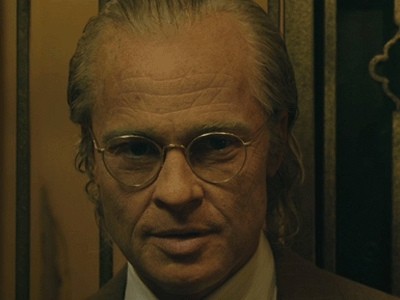
I hate comparing great films to other great films, because they don't need to ride on the coat-tails of what came before them. Having said that, The Curious Case of Benjamin Button is a great drama in the tradition of Forrest Gump. It's the story of an extraordinary man trying to lead a normal life. Such is the strangeness of his situation - born prematurely aged, his body grows younger as his mind gets older - that every 'normal' thing Benjamin does seems like a bonafide miracle.


Benjamin Button touches on themes of life, death, time, aging, and coincidence. It's a long movie on paper, but in dealing with the passage of time, it never feels long. I kept wanting to see what was around the bend in the life of this curious man. There are many moments of levity, but the second half of the film feels heavy on the heart, and it hurts. The grounding of the narrative and the performances by Pitt, Blanchett and company really make you buy into Mr Button's weird and wonderful tale.


When the credits roll, watch all the elderly people leave the cinema. You'll find yourself wondering how young they are.
 
OVERALL SCORE:


5 out of 5 Red Tri-planes

05 July 2008

Review on the Run: Hancock.

I went in with fairly low expectations, and I have to say, I was pleasantly surprised with Hancock. Once you get past the five-minute slapstick opening (CG seagulls - you'll see what I mean), it's all smooth sailing. Probably the best performance was given by Jason Bateman, who plays a struggling PR man. He finds new purpose in improving the super-lout's public image, but he certainly gets more than he bargained for.


There's a few nods to other superheroes here and there, including Iron Man and The Hulk, mostly because Hancock's always getting drunk and breaking things. But even if you're not a comic-book nerd like myself you'll find plenty to enjoy. CG seagulls aside, my only real gripe with the film is the lack of a real imposing villain. Of course, my points of reference are Lex Luthor and the Joker, so that comparison may not be fair.

18 April 2008

Review on the Run: One Man Star Wars Trilogy.

A Star Wars movie marathon in an hour and a half?!
You better believe it, kid.

Charles Ross is Luke Skywalker in: One Man Star Wars Trilogy.

Last week I had the privilege of seeing Charles Ross' One Man Star Wars Trilogy at Brisbane's Cremorne Theatre, in the Queensland Performing Arts Centre. The curtains opened, and there was Charles dressed in black, zooming around the stage. He proudly trumpeted the 20th Century Fox Fanfare and then the Star Wars Theme. What first impressed me was Ross' attention to detail. He didn't indulge in needless geek-isms (though he probably could have) like rattling off the receding prologue, rather he only used those elements most pertinent to the plot and the comedy. In this instance he used the suggestion of an opening crawl to underscore the comedy. Indeed, a great deal of the laughs were sourced from his clever gestural comedy: any Star Wars fan could tell when he was an X-Wing, a TIE Fighter, or Jabba the Hutt. His impression of a fallen Imperial Walker is absolutely priceless.


Charles Ross' delivery was spot-on. It's almost as if George Lucas was backstage the entire time, egging him on: "faster, more intense!" His Luke Skywalker was an exceptionally fast-talking, whiny farmboy, and kept the plot moving at a brisk pace. Clocking in the entire Trilogy at one and a half hours is no mean feat for one actor, and frankly I'm surprised he still had breath in him by the end. That's probably the most impressive part of the show; that one man can supply enough energy on-stage (with no props, mind you) to conjure an entire universe in the collective mind of his audience.

His sound effects were brilliantly replicated, from the screaming TIE Fighters to R2D2's bleeps and croaks. While he rarely deviated from his regular vocal timbre, his meticulous phrasing and pacing perfectly encapsulated each character. His most notable characterisations included Jabba the Hutt, Yoda, and my personal favourite, the Emperor. Ross' sketches were almost satirical, poking fun at Hamill's [and McDiarmid's] over-acting, and inconsistencies between the movies, but always with love and respect for the source material. Think of it as a playful jab in the ribs to a close friend. Surprisingly, prequel ridicule was kept to a minimum, but as Lord Vader said, it'd be all too easy to traverse that well-worn road.


Charles Ross is Master Yoda in: One Man Star Wars Trilogy.

In many ways, Charles Ross' performance highlighted the failure of Jar-Jar Binks as comedic relief. While in the Original Trilogy, comedic duties were shared by the entire cast and weaved into the story, the Prequel Trilogy attempted to project all of its comedy onto one character, and as a result, poor Jar-Jar stood out like a sore thumb in an overly serious universe. Here Charles is simply fleshing out what is already there; a comedy goldmine of science fantasy. He seemed to have the most fun with Return of the Jedi, like a child playing with his Ewok figurines. In this act he threw in more asides than usual, and really enjoyed hamming it up as Emperor Palpatine.

The most interesting thing to me was what he chose to keep and what he chose to leave out. One thing's for certain, he always chose the scenes and dialogue that were a) most important to the plot's momentum, and b) rich with comedic potential. Ross often avoided more obvious gags to highlight dynamics of the films that I hadn't even thought of (and I've seen the films many, many times). His familiarity with the films and the script was apparent to everyone in the audience - he probably could have rattled off the entire thing - right down to the musical cues, transitions and scene cuts, which he also humorously enacted.

At the conclusion of Return of the Jedi, Charles took the time to have a chat with the audience about the show's history, and how he came to tour the world doing what he loves. He really is a very endearing character in and of himself. All in all, the One Man Star Wars Trilogy gave nothing of the impression of a geek's self-indulgent dream, and everything of a seasoned actor and comedian's finely crafted stage play. If you ever wanted to watch all three movies in a row, save yourself some time and see Charles Ross. He packs all of the magic of Star Wars into one and a half hours, and plenty of laughs as well. I highly recommend this show to any Star Wars fan, or anyone with an appreciation of the films. If on the off-chance you're unfamiliar with that galaxy far, far away, rent them out then go see this show!

Charles Ross closed with the announcement that his next show will be the 'One Man Lord of the Rings Trilogy'. I for one can't wait to see it.