Showing posts with label Thoughts. Show all posts

26 November 2011

Born to be Wild

Get back to where you once belonged.

When I heard that the next Call of Juarez would likely return to the wild, wild west, I was not surprised.  In fact, I was more surprised that the latest entry, The Cartel, was set in modern day LA.  In retrospect, this deviation from the series (along with a few others) was actually quite disastrous.  It wasn't long ago that Red Dead Redemption brought Westerns to the forefront of videogames.  A year later and another Western could have recaptured an audience itching to get back in the saddle again.  Instead, Ubisoft released another modern-day shooter into a world already weary of modern-day shooters.

The frustrating thing is that it really wouldn't have taken much to change Call of Juarez: Bound in Blood from a faint curiosity to a must-play title.  The critical consensus was that Call of Juarez seemed like it was designed to be a co-operative shooter, only to have that feature cruelly stripped away from it (presumably due to time constraints).  Now, I don't know how true or practical that even is, but the fact that they jumped from no co-op at all to three-player co-op in its sequel seems rather ludicrous.  The series has traditionally revolved around three characters, but prior to this has only ever featured two during gameplay (which I think makes perfect sense).

The other consensus view was that the game's authentic western feel was its greatest asset.

I suppose what I'm getting at is that Call of Juarez: The Cartel seems to have overcomplicated a rather simple equation for improving upon its predecessor:

Western + Shooter + Co-op = WINNER!

06 October 2011

Capcommunity


I haven't felt this daft in a long time.  I've been gorging myself on press releases from Capcom for more than a decade and only now has it dawned on me: 'Capcom Unity' is short for 'Capcom Community'.  I only realised this as I was listening to Destructoid's Podtoid and they were discussing how community managers copped a lot of flak for corporate decisions that even they are bummed about.  When the discussion moved onto Seth Killian, Community Manager at Capcom, and the healthy relationship the company has fostered with its fans, I finally saw the title of their fan site the way I was always meant to: Capcommunity.

Of course, once I realised why it never dawned on me, that cloud of daftness lifted immediately: it's not my fault I didn't get it, it's Capcom's!

See, it all comes back to the basic rules of grammar.  If you want the end of the first word to form the beginning of the next word, they need to flow together.  Putting spaces or hyphens in between two words breaks that all-important flow.  In poetry, a hyphen indicates a four-second pause - that's the longest pause in poetry.  Officially, Capcom-Unity is hyphenated, however, many gaming news articles have named 'Capcom Unity' as the source over the years.  And that's why I've never read the word the way Capcom intended all this time.  So there.

And so it comes to pass that my humiliation has been replaced with indignation. 

Dear Capcom,

If you want people to understand your clever pun, you're going to have to put those words together.  And you're going to need another 'm'.

Ladies and Gentlemen, I present to you:

Capcommunity.

02 October 2010

Toejam & Earl: Random Acts of Kindness, Part 2.

I was talking with a friend before a wedding last week, which somehow led to a discussion of 'True Random', and how it could not be replicated outside of the natural world (e.g. by a computer). My friend asked me for an example of 'True Random' in the natural world, and the best I could do at the time was the branch growth patterns of a tree, which I'm sure is a popular example in physics classes, but not one that I was entirely satisfied with. Then during the wedding, something amazing happened. The flower girl came swinging through the wedding ceremony like a wrecking ball. She can't have been older than four years old, but she stole the show because nobody knew what she was going to do next. I pointed her out to my friend (not that I needed to - everyone was looking at her), and said "that, my friend, is True Random". She smiled and nodded in agreement. (protip: don't ever get a flower girl for your wedding - at least not one that is under 6 years old with ADD - I have never seen this go well.)

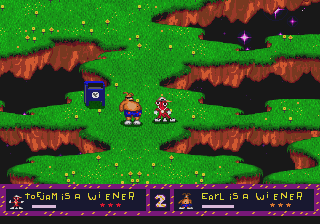
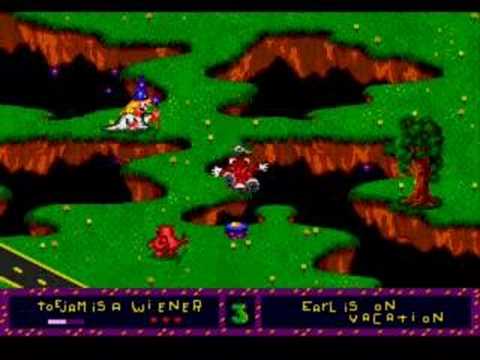
The Earthlings in Toejam & Earl are no different.

Toejam & Earl

3. Earthlings
When a Cupid fires an arrow at Toejam or Earl, they fall under a lovestruck stupor, and their D-pad directional controls are immediately jumbled (up becomes down, and down, up; or up is left and down is right - all manner of configurations are possible). Your controls remain in a state of disarray until the love spell wears off, so it's important to adjust quickly and get the hell out of there - each additional hit from Cupid's arrow not only refreshes the spell, but re-jumbles the controls as well. It's not until recently that I've realised this is a 'status effect' just like those found in RPGs (and of course, Roguelikes), albeit presented in a far more dynamic and tactile way.

Santa Claus is a similarly fictitious and random Earthling. You can never really tell when or where he'll make his next appearance. He seems to be attracted to levels with large expanses of water, but even that's not a hard and fast condition for a visit from this reluctant helper. I say 'reluctant' because he will only bequeath presents to those savvy enough to sneak up on him.
***
As an aside, Toejam and Earl can sneak up on sleeping enemies (and Santa Claus) by holding down the action button. This is the default function of the action button, which I think is a great idea, and as a Sonic fan, I believe this should be implemented in most platformers. [One of the few frustrations I have with the Mario titles is having to hold down the 'run' button for the duration of entire games. It should be replaced with a 'walk' button, and Mario should run by default.] Back to sneaking: occasionally - perhaps once or twice during the course of an entire game - Toejam or Earl will let out an almighty sneeze, blowing their cover and waking up a sleeping Earthling (or alerting a rummaging Santa). If a second player is present, he will say "gesundheit", which is a nice touch to this well-loved cartoon trope. Similarly, Earl's pants fall down (much to his embarrassment) at random junctures, which never seems to get old. It's these spontaneous events that really contribute to this sense of a living, breathing world filled with living, breathing characters.
***
When it comes to sneaking up on Santa, there is an added requirement for stealth success. The player has to sneak while he's rummaging in his sack, and stand dead still whenever he stops to look around. If the player manages to touch him when he's not looking, Santa drops an undetermined number of presents. If the player's spotted, Santa flies away in his jet pack to another random spot on the map. Both outcomes have an element of randomness.

There are Earthlings that likewise sneak up on Toejam and Earl, like Boogie Man for instance, but a far more compelling example of this can be found in the Mailbox Monster. Now, you'll likely encounter many a mailbox during the course of a game, but if you're anything like me, you'll damn near avoid the buggers every time. Walking past a mailbox is like waiting for the axe to fall, because the possibility of it being a Mailbox Monster is always looming. There's only two ways to find out if a mailbox is bonafide. Either you'll stand next to it, in which case it will offer a mail order (mailbox) or enter its frantic dance of death (Mailbox Monster). If you're lucky, you might catch an imposter shifting its eyes from side to side, and avoid such trial and error terror. The Mailbox Monster moves with existential panic, as if it's somehow shocked to be a monster, and that's what makes it dangerous.

There's only one 'Earthling' more erratic in its movements, and that's the Tornado. They can spring up from anywhere in the desert areas, but you can bet your bottom dollar - they're heading straight for you. It's nigh-on impossible to predict where a Tornado may take you once it's swept you off your feet, but its strong sense of sentient ill-will tells you it won't be anywhere good.


Toejam & Earl

4. Geography
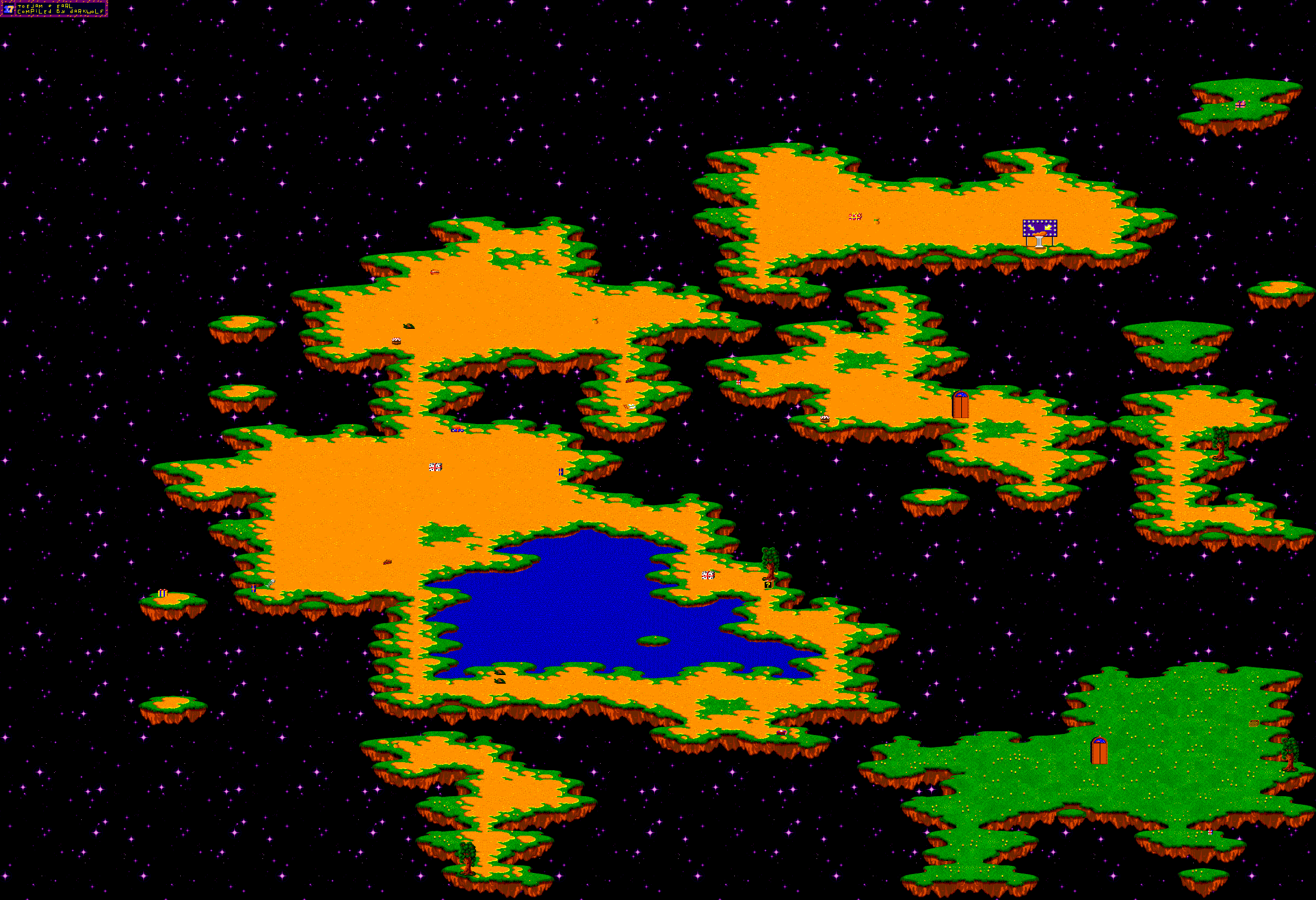
Which brings me to geography. The Earth, according to Toejam & Earl, is flat, perhaps as a comment on the backward savagery of its denizens. Each level of 'Earth' as it were, is a series of islands large and small suspended in space. This means there is an edge to every level, and Toejam and Earl can fall off, either through clumsiness (walking lovestruck in the wrong direction), item expiry (running out of Icarus Wings in flight), or enemy interference (the aforementioned Tornado drop). And when you do fall, you could land anywhere on the previous level. You could even land on a remote 1 x 1 square island, necessitating further falling until you can actually reach an elevator.
***
Or you can do what my brother and I do, and that's fall right back down to Level 1 so that we can visit the secret Level 0. I won't spoil things by telling you how to get there, but I will tell you that once you fall off Level 0 you return to the furthest level you originally fell from to get there.
***
However random it is, you do get a sense of the game's geography after multiple playthroughs. Quite often a secluded island can only join the mainland by revealing secret corridors, which are 'triggered' by surveying the coastline. In a puff of smoke, and the buzz of a sawmill, the corridor paves itself and winds its way across the void. Pursuing the new path often yields further revelations until it links with another body of land or intertwines with other corridors; other times it yields nothing and leads nowhere: random for the sake of random.

You can also reveal remote sections of the map at random by picking up a telephone, which - you guessed it - appear at random.

Toejam and Earl


5. Conversation
Speaking of telephones, or speaking of speaking, the conversation in Toejam & Earl also adds to its overall spontaneity. In a two-player game (yet another reason I espouse the superiority of the two-player TJ&E experience), the titular characters discuss all manner of things between levels, from the insanity of Earth's inhabitants to the awesomeness of their progress, to the origin of the smell in the elevator [hint: it was Earl]. While there are only so many conversations to be had between the two, you'll never hear the same conversation twice, nor will you hear them in the same order. There are other conversations to be had in-game, either in response to stimulus material ("aloha/hubba hubba" in the thrall of a Hula Girl, for instance), or to greet each other upon re-uniting.

And sure, sometimes it's hilarious, other times it's dated, but all of the time it contributes to the anything-can-happen-and-will thrill of this strange little game called Toejam & Earl.

22 September 2010

Toejam & Earl: Random Acts of Kindness, Part 1.

There's only one videogame that every member of my family has played, and continues to play after 18 years:


My brother comes home from Japan (the Land of Videogames) after working there a year, and what's the first thing he wants to do? Play Toejam & Earl with me. So we play Toejam & Earl, and we still love it. And for good reason: its funk soundtrack is, in this writer's humble opinion, the greatest to ever be committed to cartridge. Its cartoon stylings capture perfectly the dissonance between our duo of chillaxed aliens stranded on a frenetic, hostile Planet Earth. It was both an hilarious parody of hip hop culture and a devilishly clever satire on modern Earth life. In an age when local multiplayer is treated as indulgence, and cooperative play a fiscal liability, Toejam & Earl represents one of the most delightful experiences that can be shared with two controllers. All of these things comprise the funny, funky package that is Toejam & Earl, but they are not reason enough for its remarkable longevity. There are many other titles that could be said to be "the full package" and yet I can almost guarantee I won't be playing them in 18 years time. Those who have played Toejam & Earl will find all this talk of packages to be rather apt. The game is every bit as surprising as the wrapped gifts that feature so prominently in it. If I could summarise the essence and appeal of Toejam & Earl in a single word, that word would be 'Random'. No two play-throughs of Toejam & Earl are ever the same, lending the game virtually limitless replay value. Let's explore this Funkotronian phenomenon to see how it achieves this rare feat.
1. Random World The game begins with a choice of either 'Play New Game -- Fixed World', 'Jam Out', or 'Play New Game -- Random World'. Now, the Fixed World features set levels that will always be the same geographically, with set locations for ship pieces [your goal is to reconstruct your broken rocketship, the parts of which are scattered throughout the game] and elevators [the end of each level]. Just about everything that populates them remains random, but it's good if you're strapped for time and you need a ball-park game length. Random World is a huge part of the game's appeal. This is the mode that seasoned players return to time and time again, because the experience is always different. It's always different anyway, for reasons I will go into later, but the geography is never the same. Sure, it follows guidelines - for instance, Mailbox Monsters are not introduced until Level 4, quicksand will only enter the game's repertoire by Level 6, and Level 13 is invariably a warzone packed with tomato-firing chickens with mortars - but it's not a random selection of pre-drawn levels; each level is randomly generated; each Earthling, item, and elevator randomly placed; and each ship piece randomly scattered throughout the game. This is why it is often referred to as a 'Roguelike' - a reference to the dungeon-crawler Rogue which popularised the use of randomly-generated levels and items - despite its distinct lack of dungeons or crawling. But you'll soon see how Toejam & Earl takes this formula even further. Anyway, with circumnavigation playing such a major role in the game, it's easy to see how much an ever-changing landscape can add to its replay value. 'Jam Out' has got to be one of the world's first music rhythm games. It essentially showcases the game's excellent jazz-funk/hip hop soundtrack, allowing you to play beats or in-game sound effects over the top with both controllers. This mode comes in both 'Fixed' and 'Random' flavours also, assigning either preset beats to each button in the former, or allowing the player to switch between randomly-assigned sound effects from the game in the latter, often to hilarious results.

2. Presents For all its apparent hellishness, planet Earth seemingly has a lot to give as well. There are myriad presents scattered about each level, and these gift-wrapped wonders are the cornerstone of the game's evergreen appeal. Each present is a veritable Pandora's Box, with the curiosity/caution-inspiring '????????' beside each one in your inventory. That is, until you open one, and all other presents that share its appearance are now known to contain that particular item. A small, red box with a yellow bow could be a pair of spring shoes in one game, or rocket skates in another. A large, pink box with white polka dots could be five bucks, or it could just as well be a nasty bout of tomato rain. As long as they remain unopened, they have the equal capacity to be something awesome, something utterly life-threatening, or something downright useless in certain situations. Some presents remain random even when their contents are known. 'Food' could be something tasty that increases your life-bar, or something awful that diminishes it. With two players together, the 'food' present can be beneficial to one while harmful to the other, and so forth. The 'Earthling' present could yield a helpful Viking lady or a swarm of killer bees. The 'doorway' present reveals a mystery door that when walked through, transports the player to a random place on the map. If both players are present, that same doorway will lead to two completely different locations. Presents with question mark ['?'] wrapping are other presents in disguise; random within random. This process of discovery can be immensely satisfying, but each present opened brings you one step closer to accidentally opening the dreaded 'Randomizer', which re-shuffles the appearance and contents of every single present in your possession, and in the game. Of course, you could be lumbered with a swag of undesirable items, in which case another spin of the roulette wheel may not be such a bad thing. It's just one of the many ways that TJ&E continually changes itself up, even mid-game.

12 September 2009

Could Sony and Microsoft's 'Cold War' Business Model Drive Them Out of the Console Business?


It's no secret that Nintendo's 'blue ocean' strategy has been working wonders for the Wii, maintaining consistently high hardware sales at a profit from month to month. While Nintendo frolics carefree in the open sea, Sony and Microsoft have been locked in a war of attrition, amassing arms for control of the same bloodied waters. According to DFC Intelligence analyst David Cole, this 'cold war' of sorts is not sustainable for either party. Let's take a look at some of Cole's main points, and see what it means for the videogame industry at large:

"The bottom line numbers for Sony and Microsoft’s game business are not pretty. From fiscal 2007 to fiscal 2009, Sony’s game division showed an operating loss of well over $3 billion. Meanwhile, during the period from 2004 to 2009, Microsoft’s Entertainment & Devices Division has lost over $4 billion. Much of this loss can be attributed to the cost associated with launching a new console system that is sold at a loss. The reality is Sony and Microsoft really need their hardware systems to have a true 10-year lifecycle so that initial costs can be amortized."

It makes one wonder why these two companies have fought tooth and nail to keep their fingers in the gaming pie. Both companies have been operating at a loss for quite some time, and both have large, more profitable stakes in other industries. The Sony brand is the most trusted when it comes to consumer electronics and home entertainment, and Microsoft has their operating system on virtually every single computer on the planet.

It also suggests that the PS3's (and to a lesser extent, the Xbox 360's) much-touted ten year life-cycle is borne out of necessity rather than any indication of the platform's long-term viability. Both companies leave their statements open to interpretation, though, and when they say "ten year life-cycle", I'm sure many of us believe they really mean, "support existing hardware for ten years, but release new hardware in the meantime." What David Cole is proposing is a true ten year life-cycle - one without the distraction of next-generation hardware until after ten years - and that's the difference.

"Both Microsoft and Sony have a long-term vision that their game boxes will eventually provide a whole host of entertainment services. The problem with that vision is both companies are still caught up in the arms race of the video game console business. It is extremely expensive to launch a new game system every few years and build an installed base from scratch. But game consumers have been trained to constantly demand a new game system and that is what drives much of the market."

 
If this is what we're expecting, what chance do they have of delivering?

"For Sony and Microsoft, it simply makes little business sense to launch a new game system. They need their current systems to last as long as possible so that they can actually make some money. What makes business sense for Sony and Microsoft is to focus on getting costs down, offering new (and profitable) services to their existing systems and looking to build renewed consumer excitement via new form factors and incremental additions like Project Natal for the Xbox 360."

This is why Microsoft and Sony will likely release another console before the ten years are up. They're damned if they do, damned if they don't. If they release new consoles before ten years are up, they threaten to prematurely kill their current hardware sales before they've even become profitable. If they don't, consumer demand and the excitement for future tech that drives their business model could wane, and the industry as a whole could take a dive:

"The game industry cycle has been driven in large part by new console launches. New game systems have consistently spurred consumer spending to new record heights, right at a time when the established systems are starting to decline. DFC has run best and worst case scenarios for the current generation game systems and in all scenarios, they show a decline in sales over the next several years. Furthermore, with these systems, a growing portion of consumer spending will continue to shift to catalog product, used games and rentals."


Can Microsoft afford to put a spaceship in every home?

"In short, without a major new console system to pump up consumer enthusiasm the game industry faces an inevitable decline."

So even though neither Sony or Microsoft can afford to launch a new console anytime soon, they may have to break their 'ten year rule' just to stimulate sales. It's clear that both Micosoft and Sony are attempting to address this with console 're-launches', in hopes that Project Natal and the PSEye Wand can fuel another five years of sustainable sales, but how realistic is that? And will it drive their price tags back up?


Can Natal push the Xbox 360 over the ten-year finish line?

I suppose in many ways the Wii was a re-launch of the Gamecube with motion controls, but all that really means is that Nintendo pre-empted the potential destructiveness of the console arms race that Sony and Microsoft remain locked in, and bowed out when the time was right.

"For Nintendo, the business model for launching a new console system every five years could still work because they focused on keeping overall hardware costs low by not pushing the technology barrier. Does this mean Nintendo may be the first to launch a new system by 2012? That would be a first for a company with a market-leading platform. Then again, doing so could also really put competitive pressure on Microsoft and Sony."


Could Nintendo feasibly force Sony and Microsoft into a corner by releasing early? Or could they force them out of the business entirely? Just how much money is Sony and Microsoft willing to lose before they say, "enough is enough" and pull out altogether? It's an interesting thought, and one that I can't say I've entertained up to this point.


What do you think about all this? Will Sony or Microsoft break their 'ten-year rule'? Can they afford to? Or will their console 're-launches' be successful enough to keep them afloat?

10 September 2009

Sonic: Do We Dare to Dream in HD?

"Sonic is back!"

If I had a dollar for every time I've heard those three words, I'd have at least eight dollars by now. Here's another quote for you:

"Once bitten, twice shy; three times the fool - anything more than that and you must be a Sonic fan."
I'll admit, the Dreamcast's anniversary has refreshed my optimism, and interviews around the traps indicates Sega has an inkling of what made the machine so great in the first place, BUT--

The real question here is whether anyone at Sega has an inkling of what made Sonic so great in the first place. And the more frightening question is whether the Sonic fans they've supposedly been listening to have a clue either. Trawl through the comments thread of any given Sonic game review - if you handed any one of these people the reins, the results would be disastrous (Frankensteinian, even).

One thing that rings alarm bells to me is the opening two words of the 'Project Needlemouse' trailer:


Did it ever really leave?

I don't recall anyone complaining about the lack of speed in a Sonic title over the past fifteen years, do you? That didn't seem to stop those games from sucking, though, did it? Don't think for one second that I'm actually advocating a slow Sonic the Hedgehog title [Exhibit A: Werehog]. What I'm saying is that speed isn't it. It's not what made the Sonic games great. It's the most popular misconception about the series, and one that I believe has been perpetuated by latecomers to the party, and outsiders looking in on the original experience.

If Sonic was *just* about speed, or even mostly about speed (which again, it was not), then there'd effectively be nothing wrong with any of them. And yet, I'm sure we all agree they're missing something [or somethings] vital.

What's missing is Sonic's 'Lone Ranger' coolness. Even Tails was an unwelcome addition to the formula in my books - he's without a doubt the Robin of the Sonic series, albeit without any conceptual merit whatsoever [except perhaps a counterpoint to Sonic's seriousness?]. His appearance in Sonic 3 had merit from a co-operative gameplay standpoint, but ultimately he was just another hurdle to the game's momentum, and the true test of a Sonic player's skill was to see if Sonic could reach the same areas Tails could without the aid of flight. Sonic Team seem to have had recognised and remedied this in Sonic & Knuckles (for the record, though, Sonic 3 remains my favourite game of all time).

What's also missing is Sonic's 'silent ninja' demeanour. Just look at his facial expressions in-game - sure, he's got attitude, but he's no smart-ass - he's deadly serious about what he has to do. The biggest mistake Sega ever made was to let Sonic open his apparently Steve Urkel mouth in the cartoons, and then allowing that 'attitude' to feed back into the videogame series. The voice just killed it. Sonic went from cool to '
the cool kid at school' in one fell swoop. And that's not cool.

Of course, the transition to 3-D hasn't helped. Jonathan Blow said it himself - the mechanics of the platformer were designed to operate on a 2-D plane - and even Nintendo seems to have realised this with New Super Mario Bros. Wii on the way. The satisfaction of precision jumping is lost in a 3-D platformer, and that was a BIG part of Sonic's gameplay. There have been many glamorous transitions from 2-D to 3-D, but you will find that it's the atmosphere and audiovisuals that have supplemented any design compromises that were necessary to accomodate the extra dimension.

But probably the number one thing that's been missing from the Sonic series is secrets. Let's have a show of hands, veteran Sonic players - did you breeze through every level at breakneck speeds on your initial play-through? Or did you try to collect all the rings, search for secrets, and enter all the special stages for Chaos Emeralds? Yeah, I thought so. Nearly all of this has been lost, not just in the 3-D outings, but all Sonic titles from DS to PS3. Exploration - real, on-the-run exploration. Multiple routes - vertical as well as horizontal scrolling, breakable walls, burrows, springboards hidden in trees, water/fire/electricity shields, bonus stages - all of these intricacies have been lost on the post-Megadrive Sonic game. I'll be interested to see if they make a return in Project Needlemouse, but I'm not holding my breath.


Needlemouse: fingers crossed it won't sting too much.


One encouraging thing was Ken Balough's acknowledgement that the daytime levels of Unleashed were the game's strength. Here's my thought on just about every single 3-D Sonic title ever released: Sonic Team would carefully craft some brilliant speed runs for Sonic, and worrying that the game was not long enough to warrant full price, padded out the experience with ancillary characters, arbitrary story, and menial tasks for Sonic and friends to perform. They practically crammed a fishing game in there, folks! If Sonic Adventure was just the levels strung together, it would be shorter, but it would undeniably be a better game. Sure, it had collision detection issues, the lock-on jumping kind of sucked, and it lacked the elements I've already mentioned, but the levels themselves were quite well-designed. I'm sure the same thing occurred with Unleashed - the Werehog was added because Sega felt that the core game was too short. Perhaps that was the result of extensive focus testing - by the way Sega, can you please stop doing those? I feel crazy dangerous saying something like this, but go with your gut, Sega. These uncertain afterthoughts have been ruining your games.


The inference here seems to be that Project Needlemouse will be a downloadable title on Xbox Live and PSN. If so, it won't matter how short the experience is, so long as every moment is golden. When people pay $10 for a downloadable title, they're not expecting a 10-15 hour game; they're expecting a polished, streamlined experience. If the intended audience is indeed the older gamers who grew up with the 2D Sonics (which seems to be the case), then digital content will reach that audience. If I'm correct in my assumption, this is the smartest move they could have made.


My skepticism is still well and truly alive, but I will be watching the progress of Project Needlemouse with keen interest.

19 January 2009

Console Q & A with The Red Baron.

I thought I'd share with you all my opinions on this generation of consoles through this email I recently received from a friend today. It looks like he's seriously considering purchasing a console, particularly a 360...


Dear Sir,

I am writing to you because I consider you a paragon of gaming console knowledge, and seek your advice.

To assist in this process, I have formulated several questions which I humbly implore you to answer.


Firstly, allow me to thank you for your sincere flattery - it will get you everywhere - and your humble imploration.


General

1) In your opinion, which console - overall - is the "best"?


Let's be honest here, the Xbox 360 really is the best console this generation, for reasons that will be stated in the following question. As a Wii owner, a displaced Sega fan, and a gamer, I'll be the first to admit it. But one glaring black mark against its name is the console's infamous unreliability: RROD. This may not be a problem with 360s manufactured since late October, which I'll expand on later.


2) In your opinion, which console has the best games?


The Xbox 360, hands down. It has the most 'great' games in its library. But it does depend a great deal on what type of games you like, and what type of gamer you are. If you are not into first-person shooters, for instance, or you play FPSs predominantly on your PC, then this greatly diminishes the who's who list of 360 titles. In terms of playing games unique to the console, the Wii probably has the strongest library. Nowhere else will you be able to play games like Wii Sports, or a Nintendo game like Mario Kart.


3) In your opinion, what are the two best games for each console?


I'm picking exclusives here, but there are plenty of great multi-platform games on the 360 and PS3 (most of which are superior on the 360, in my estimation):
Xbox 360 - Gears of War, Fable II
PS3 - LittleBigPlanet, Resistance 2
Wii - Super Mario Galaxy, de Blob


Xbox-Related

1) Do you own an Xbox 360, and if so, do you also have Xbox Live?


No and no.


2) If not, have you at least played it, and what do you think of it?


Yes, and Xbox Live is great and all, but when you're used to online gaming on a PC, I doubt it will blow your socks off given you have to pay subscription fees. As far as online console gaming, though, it's unparalleled. A lot can be said for online community AND it's evil cousin headset-spamming, too. Whether the difference between it and the Playstation Network is substantial enough to warrant said fee is hard to say - unfortunately I've not yet played online with a PS3. Mario Kart Wii is probably the smoothest online console game you'll ever play, though.


Lastly;
At $400 (AU) for an Xbox 360, plus paying for games, extra controllers, accessories and Live subscription, is it really even worth it...or should I just stick to my PC?


Again, it depends what you'll be playing on it. I'm looking at a list of '9' games on IGN and here's what I get:

Grand Theft Auto IV (uncensored on PC in Australia, and let's face it, GTA controls are always better on PC), Bioshock (also on PC & PS3), Fallout 3 (also on PC & PS3), Gears of War 2 (exclusive, FINALLY!), Fable II (now we're getting somewhere), Gears of War (also on PC, but likely better on 360), Prince of Persia (also on PC & PS3 AND not as good as Sands of Time), Mass Effect (allegedly improved and less-buggy on PC), Call of Duty 4 (probably better on PC)...you get the idea.

If you want racers, fighters, or sport games, then go for it - there are a few non-shooters I can recommend. If you like predominantly FPSs and RTSs, then you should probably stick with the PC. With the exclusives, you've really got to decide just how badly you want to play a certain game. It could well be worth it.

To put the value in perspective, I bought my Wii for $500.00 at launch with Wii Sports, Zelda, and an extra Wii-mote. The 360 is a three year old console, so perhaps they're demanding too much still. Provided your computer requires no upgrades, you could feasibly purchase Mass Effect, Fallout 3, Far Cry 2 and Red Alert 3 for less than the cost of a 360. Hell, I think I just talked myself out of it.

IF you choose to purchase a 360, make sure you purchase one of the new 'Jasper' units. It should be far less susceptible to overheating and RROD. You can determine this by checking the amperage next to the serial barcode:


12.1 Amps good, 14.2 Amps bad!

Check here for more detail on that.

BOTTOM LINE: If you like the sound of Viva Pinata, Gears of War 1 & 2, Fable II and Ninja Gaiden II, then go for it. Those are the best 360-only games around in my estimation.


Thanks in advance,

Buddy O. Pal


No worries, mate. I hope I helped more than I confused.


Feel free to weigh in with your own opinions so that Buddy can make up his buddy mind.