03 October 2010
Sega Rally: Arcade Perfect.
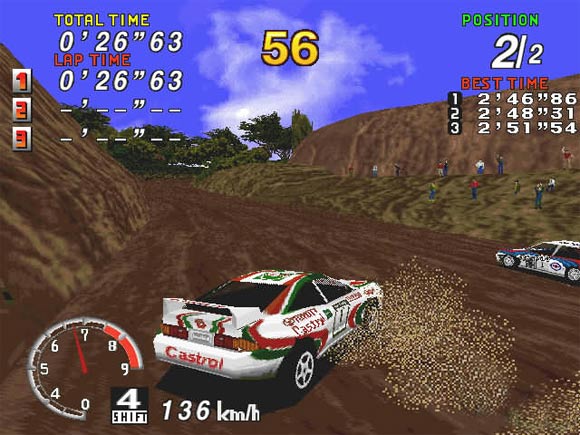
Back in the 32-Bit era, arcade perfection was the Holy Grail of game development. It was the question on everybody's lips: "yeah yeah yeah, that's great, but tell me - is it arcade perfect?" It's a strange term looking back, now that consoles have spread their wings and arcades the world over die a slow and painful death, but 'arcade perfect' was once the highest praise you could lavish on a home conversion. I'd say we've come a long way since then, but by demanding more than mere perfection (and getting it), we've eroded away the canal that birthed games like Sega Rally. Sega Rally Championship for the Sega Saturn is arcade perfect. But it's more than that - it's just plain perfect. Some may find this hard to believe approaching it retrospectively - sure, polygon counts and texture maps have improved since then - but mark my words, no rally game since has even touched its handling or track design.
Sega Rally is the poster child for "quality over quantity", sporting only three tracks (Desert, Forest, Mountain - four if you include the secret Lakeside track) and two vehicles (a sixth generation Toyota Celica, and a Lancia Delta HF Integrale - three if you include the secret Lancia Stratos). The Desert track is the shortest and simplest of the three, giving the player a taste of turns to come, and offering insights into the very different but equally viable behaviours of its two main characters: the long-horned Celica that throws its weight into corners and gains on straights, and the tight-turning Tom Thumb wonder that is the Delta. And yet the Desert has a flavour all its own, of salient jumps and short, sharp chicanes. The Forest track is all business until it reaches its centrepiece, the hairpin right, putting you through the ringer all the way to the checkered flag. And the Mountain track is as wild as a bucking bronco, offering very little reprieve for the unfocused rider.
Today's game players would baulk at such a limited selection, but I defy them to find three more expertly crafted tracks in any rally game (or indeed, any racing game), or two cars to race on them that ever felt this right. This is not nostalgia talking here - this is the same Sega Rally that kept my housemate and I up nights last week. It's a rare treat to have two equally matched Sega Rally players under the same roof, but that is what we have at my house. The thrill of waiting for your opponent to slip, and power-sliding past him to the finish line; the satisfaction of licking the wall on a perfectly executed hairpin turn; the friction of tyres to asphalt, to gravel, to mud; the superbly balanced handling; these are sensations I could never adequately describe or replicate.
So here's to you, Sega Rally, King of Rally Racing. Don't ever change.
Labels:
Reviews
02 October 2010
Toejam & Earl: Random Acts of Kindness, Part 2.
I was talking with a friend before a wedding last week, which somehow led to a discussion of 'True Random', and how it could not be replicated outside of the natural world (e.g. by a computer). My friend asked me for an example of 'True Random' in the natural world, and the best I could do at the time was the branch growth patterns of a tree, which I'm sure is a popular example in physics classes, but not one that I was entirely satisfied with. Then during the wedding, something amazing happened. The flower girl came swinging through the wedding ceremony like a wrecking ball. She can't have been older than four years old, but she stole the show because nobody knew what she was going to do next. I pointed her out to my friend (not that I needed to - everyone was looking at her), and said "that, my friend, is True Random". She smiled and nodded in agreement. (protip: don't ever get a flower girl for your wedding - at least not one that is under 6 years old with ADD - I have never seen this go well.)
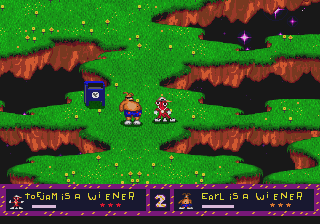
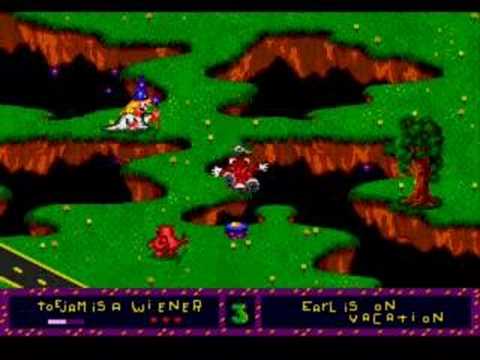
The Earthlings in Toejam & Earl are no different.
3. Earthlings
When a Cupid fires an arrow at Toejam or Earl, they fall under a lovestruck stupor, and their D-pad directional controls are immediately jumbled (up becomes down, and down, up; or up is left and down is right - all manner of configurations are possible). Your controls remain in a state of disarray until the love spell wears off, so it's important to adjust quickly and get the hell out of there - each additional hit from Cupid's arrow not only refreshes the spell, but re-jumbles the controls as well. It's not until recently that I've realised this is a 'status effect' just like those found in RPGs (and of course, Roguelikes), albeit presented in a far more dynamic and tactile way.
Santa Claus is a similarly fictitious and random Earthling. You can never really tell when or where he'll make his next appearance. He seems to be attracted to levels with large expanses of water, but even that's not a hard and fast condition for a visit from this reluctant helper. I say 'reluctant' because he will only bequeath presents to those savvy enough to sneak up on him.
There are Earthlings that likewise sneak up on Toejam and Earl, like Boogie Man for instance, but a far more compelling example of this can be found in the Mailbox Monster. Now, you'll likely encounter many a mailbox during the course of a game, but if you're anything like me, you'll damn near avoid the buggers every time. Walking past a mailbox is like waiting for the axe to fall, because the possibility of it being a Mailbox Monster is always looming. There's only two ways to find out if a mailbox is bonafide. Either you'll stand next to it, in which case it will offer a mail order (mailbox) or enter its frantic dance of death (Mailbox Monster). If you're lucky, you might catch an imposter shifting its eyes from side to side, and avoid such trial and error terror. The Mailbox Monster moves with existential panic, as if it's somehow shocked to be a monster, and that's what makes it dangerous.
There's only one 'Earthling' more erratic in its movements, and that's the Tornado. They can spring up from anywhere in the desert areas, but you can bet your bottom dollar - they're heading straight for you. It's nigh-on impossible to predict where a Tornado may take you once it's swept you off your feet, but its strong sense of sentient ill-will tells you it won't be anywhere good.
4. Geography
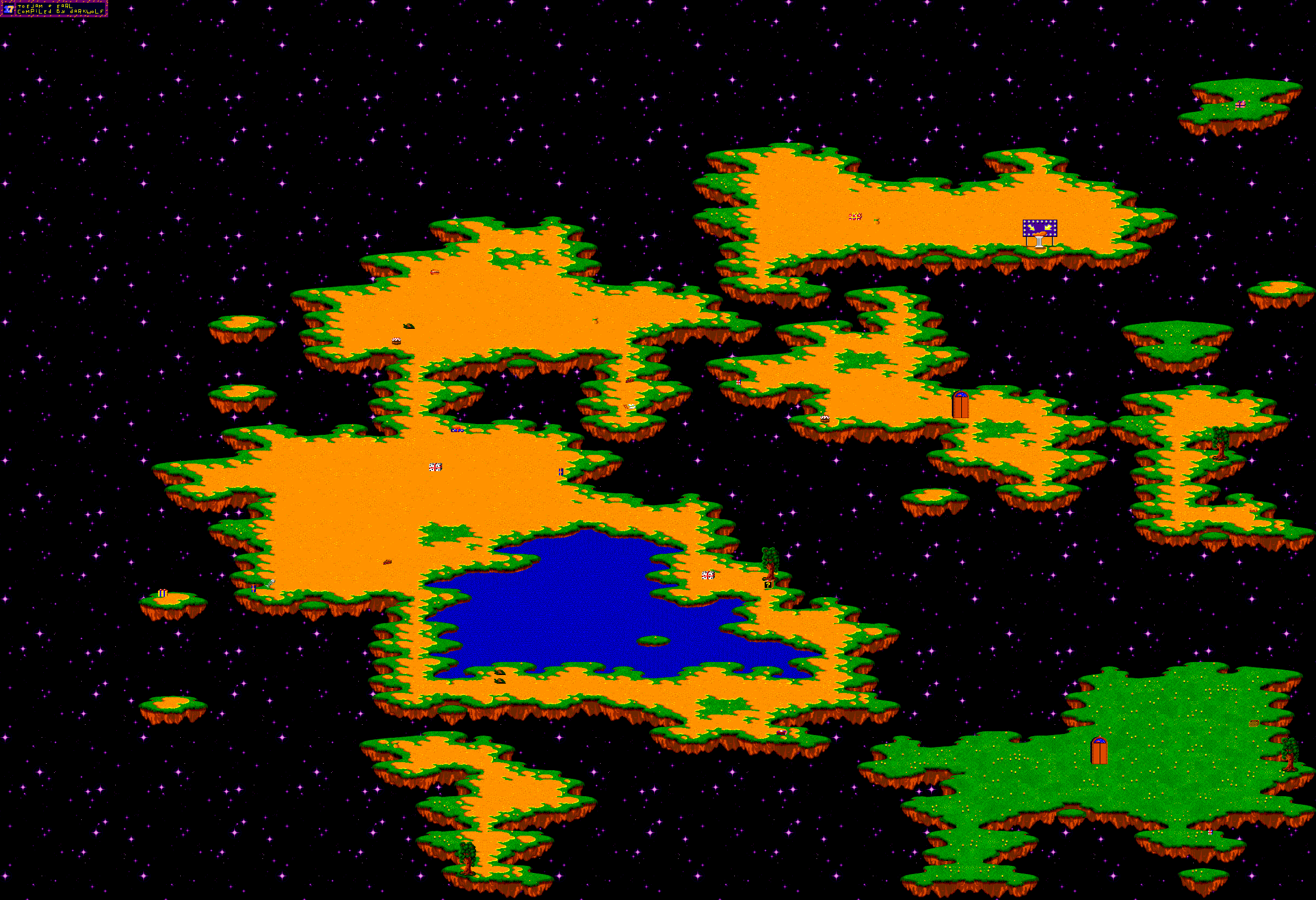
Which brings me to geography. The Earth, according to Toejam & Earl, is flat, perhaps as a comment on the backward savagery of its denizens. Each level of 'Earth' as it were, is a series of islands large and small suspended in space. This means there is an edge to every level, and Toejam and Earl can fall off, either through clumsiness (walking lovestruck in the wrong direction), item expiry (running out of Icarus Wings in flight), or enemy interference (the aforementioned Tornado drop). And when you do fall, you could land anywhere on the previous level. You could even land on a remote 1 x 1 square island, necessitating further falling until you can actually reach an elevator.
You can also reveal remote sections of the map at random by picking up a telephone, which - you guessed it - appear at random.
5. Conversation
Speaking of telephones, or speaking of speaking, the conversation in Toejam & Earl also adds to its overall spontaneity. In a two-player game (yet another reason I espouse the superiority of the two-player TJ&E experience), the titular characters discuss all manner of things between levels, from the insanity of Earth's inhabitants to the awesomeness of their progress, to the origin of the smell in the elevator [hint: it was Earl]. While there are only so many conversations to be had between the two, you'll never hear the same conversation twice, nor will you hear them in the same order. There are other conversations to be had in-game, either in response to stimulus material ("aloha/hubba hubba" in the thrall of a Hula Girl, for instance), or to greet each other upon re-uniting.
And sure, sometimes it's hilarious, other times it's dated, but all of the time it contributes to the anything-can-happen-and-will thrill of this strange little game called Toejam & Earl.
The Earthlings in Toejam & Earl are no different.
3. Earthlings
When a Cupid fires an arrow at Toejam or Earl, they fall under a lovestruck stupor, and their D-pad directional controls are immediately jumbled (up becomes down, and down, up; or up is left and down is right - all manner of configurations are possible). Your controls remain in a state of disarray until the love spell wears off, so it's important to adjust quickly and get the hell out of there - each additional hit from Cupid's arrow not only refreshes the spell, but re-jumbles the controls as well. It's not until recently that I've realised this is a 'status effect' just like those found in RPGs (and of course, Roguelikes), albeit presented in a far more dynamic and tactile way.
Santa Claus is a similarly fictitious and random Earthling. You can never really tell when or where he'll make his next appearance. He seems to be attracted to levels with large expanses of water, but even that's not a hard and fast condition for a visit from this reluctant helper. I say 'reluctant' because he will only bequeath presents to those savvy enough to sneak up on him.
***
As an aside, Toejam and Earl can sneak up on sleeping enemies (and Santa Claus) by holding down the action button. This is the default function of the action button, which I think is a great idea, and as a Sonic fan, I believe this should be implemented in most platformers. [One of the few frustrations I have with the Mario titles is having to hold down the 'run' button for the duration of entire games. It should be replaced with a 'walk' button, and Mario should run by default.] Back to sneaking: occasionally - perhaps once or twice during the course of an entire game - Toejam or Earl will let out an almighty sneeze, blowing their cover and waking up a sleeping Earthling (or alerting a rummaging Santa). If a second player is present, he will say "gesundheit", which is a nice touch to this well-loved cartoon trope. Similarly, Earl's pants fall down (much to his embarrassment) at random junctures, which never seems to get old. It's these spontaneous events that really contribute to this sense of a living, breathing world filled with living, breathing characters.
***
When it comes to sneaking up on Santa, there is an added requirement for stealth success. The player has to sneak while he's rummaging in his sack, and stand dead still whenever he stops to look around. If the player manages to touch him when he's not looking, Santa drops an undetermined number of presents. If the player's spotted, Santa flies away in his jet pack to another random spot on the map. Both outcomes have an element of randomness.There are Earthlings that likewise sneak up on Toejam and Earl, like Boogie Man for instance, but a far more compelling example of this can be found in the Mailbox Monster. Now, you'll likely encounter many a mailbox during the course of a game, but if you're anything like me, you'll damn near avoid the buggers every time. Walking past a mailbox is like waiting for the axe to fall, because the possibility of it being a Mailbox Monster is always looming. There's only two ways to find out if a mailbox is bonafide. Either you'll stand next to it, in which case it will offer a mail order (mailbox) or enter its frantic dance of death (Mailbox Monster). If you're lucky, you might catch an imposter shifting its eyes from side to side, and avoid such trial and error terror. The Mailbox Monster moves with existential panic, as if it's somehow shocked to be a monster, and that's what makes it dangerous.
There's only one 'Earthling' more erratic in its movements, and that's the Tornado. They can spring up from anywhere in the desert areas, but you can bet your bottom dollar - they're heading straight for you. It's nigh-on impossible to predict where a Tornado may take you once it's swept you off your feet, but its strong sense of sentient ill-will tells you it won't be anywhere good.
4. Geography
Which brings me to geography. The Earth, according to Toejam & Earl, is flat, perhaps as a comment on the backward savagery of its denizens. Each level of 'Earth' as it were, is a series of islands large and small suspended in space. This means there is an edge to every level, and Toejam and Earl can fall off, either through clumsiness (walking lovestruck in the wrong direction), item expiry (running out of Icarus Wings in flight), or enemy interference (the aforementioned Tornado drop). And when you do fall, you could land anywhere on the previous level. You could even land on a remote 1 x 1 square island, necessitating further falling until you can actually reach an elevator.
***
Or you can do what my brother and I do, and that's fall right back down to Level 1 so that we can visit the secret Level 0. I won't spoil things by telling you how to get there, but I will tell you that once you fall off Level 0 you return to the furthest level you originally fell from to get there.
***
However random it is, you do get a sense of the game's geography after multiple playthroughs. Quite often a secluded island can only join the mainland by revealing secret corridors, which are 'triggered' by surveying the coastline. In a puff of smoke, and the buzz of a sawmill, the corridor paves itself and winds its way across the void. Pursuing the new path often yields further revelations until it links with another body of land or intertwines with other corridors; other times it yields nothing and leads nowhere: random for the sake of random.You can also reveal remote sections of the map at random by picking up a telephone, which - you guessed it - appear at random.
5. Conversation
Speaking of telephones, or speaking of speaking, the conversation in Toejam & Earl also adds to its overall spontaneity. In a two-player game (yet another reason I espouse the superiority of the two-player TJ&E experience), the titular characters discuss all manner of things between levels, from the insanity of Earth's inhabitants to the awesomeness of their progress, to the origin of the smell in the elevator [hint: it was Earl]. While there are only so many conversations to be had between the two, you'll never hear the same conversation twice, nor will you hear them in the same order. There are other conversations to be had in-game, either in response to stimulus material ("aloha/hubba hubba" in the thrall of a Hula Girl, for instance), or to greet each other upon re-uniting.
And sure, sometimes it's hilarious, other times it's dated, but all of the time it contributes to the anything-can-happen-and-will thrill of this strange little game called Toejam & Earl.
Labels:
Thoughts
22 September 2010
Toejam & Earl: Random Acts of Kindness, Part 1.
There's only one videogame that every member of my family has played, and continues to play after 18 years:
My brother comes home from Japan (the Land of Videogames) after working there a year, and what's the first thing he wants to do? Play Toejam & Earl with me. So we play Toejam & Earl, and we still love it. And for good reason: its funk soundtrack is, in this writer's humble opinion, the greatest to ever be committed to cartridge. Its cartoon stylings capture perfectly the dissonance between our duo of chillaxed aliens stranded on a frenetic, hostile Planet Earth. It was both an hilarious parody of hip hop culture and a devilishly clever satire on modern Earth life. In an age when local multiplayer is treated as indulgence, and cooperative play a fiscal liability, Toejam & Earl represents one of the most delightful experiences that can be shared with two controllers. All of these things comprise the funny, funky package that is Toejam & Earl, but they are not reason enough for its remarkable longevity. There are many other titles that could be said to be "the full package" and yet I can almost guarantee I won't be playing them in 18 years time. Those who have played Toejam & Earl will find all this talk of packages to be rather apt. The game is every bit as surprising as the wrapped gifts that feature so prominently in it. If I could summarise the essence and appeal of Toejam & Earl in a single word, that word would be 'Random'. No two play-throughs of Toejam & Earl are ever the same, lending the game virtually limitless replay value. Let's explore this Funkotronian phenomenon to see how it achieves this rare feat.
1. Random World The game begins with a choice of either 'Play New Game -- Fixed World', 'Jam Out', or 'Play New Game -- Random World'. Now, the Fixed World features set levels that will always be the same geographically, with set locations for ship pieces [your goal is to reconstruct your broken rocketship, the parts of which are scattered throughout the game] and elevators [the end of each level]. Just about everything that populates them remains random, but it's good if you're strapped for time and you need a ball-park game length. Random World is a huge part of the game's appeal. This is the mode that seasoned players return to time and time again, because the experience is always different. It's always different anyway, for reasons I will go into later, but the geography is never the same. Sure, it follows guidelines - for instance, Mailbox Monsters are not introduced until Level 4, quicksand will only enter the game's repertoire by Level 6, and Level 13 is invariably a warzone packed with tomato-firing chickens with mortars - but it's not a random selection of pre-drawn levels; each level is randomly generated; each Earthling, item, and elevator randomly placed; and each ship piece randomly scattered throughout the game. This is why it is often referred to as a 'Roguelike' - a reference to the dungeon-crawler Rogue which popularised the use of randomly-generated levels and items - despite its distinct lack of dungeons or crawling. But you'll soon see how Toejam & Earl takes this formula even further. Anyway, with circumnavigation playing such a major role in the game, it's easy to see how much an ever-changing landscape can add to its replay value. 'Jam Out' has got to be one of the world's first music rhythm games. It essentially showcases the game's excellent jazz-funk/hip hop soundtrack, allowing you to play beats or in-game sound effects over the top with both controllers. This mode comes in both 'Fixed' and 'Random' flavours also, assigning either preset beats to each button in the former, or allowing the player to switch between randomly-assigned sound effects from the game in the latter, often to hilarious results.
2. Presents For all its apparent hellishness, planet Earth seemingly has a lot to give as well. There are myriad presents scattered about each level, and these gift-wrapped wonders are the cornerstone of the game's evergreen appeal. Each present is a veritable Pandora's Box, with the curiosity/caution-inspiring '????????' beside each one in your inventory. That is, until you open one, and all other presents that share its appearance are now known to contain that particular item. A small, red box with a yellow bow could be a pair of spring shoes in one game, or rocket skates in another. A large, pink box with white polka dots could be five bucks, or it could just as well be a nasty bout of tomato rain. As long as they remain unopened, they have the equal capacity to be something awesome, something utterly life-threatening, or something downright useless in certain situations. Some presents remain random even when their contents are known. 'Food' could be something tasty that increases your life-bar, or something awful that diminishes it. With two players together, the 'food' present can be beneficial to one while harmful to the other, and so forth. The 'Earthling' present could yield a helpful Viking lady or a swarm of killer bees. The 'doorway' present reveals a mystery door that when walked through, transports the player to a random place on the map. If both players are present, that same doorway will lead to two completely different locations. Presents with question mark ['?'] wrapping are other presents in disguise; random within random. This process of discovery can be immensely satisfying, but each present opened brings you one step closer to accidentally opening the dreaded 'Randomizer', which re-shuffles the appearance and contents of every single present in your possession, and in the game. Of course, you could be lumbered with a swag of undesirable items, in which case another spin of the roulette wheel may not be such a bad thing. It's just one of the many ways that TJ&E continually changes itself up, even mid-game.
My brother comes home from Japan (the Land of Videogames) after working there a year, and what's the first thing he wants to do? Play Toejam & Earl with me. So we play Toejam & Earl, and we still love it. And for good reason: its funk soundtrack is, in this writer's humble opinion, the greatest to ever be committed to cartridge. Its cartoon stylings capture perfectly the dissonance between our duo of chillaxed aliens stranded on a frenetic, hostile Planet Earth. It was both an hilarious parody of hip hop culture and a devilishly clever satire on modern Earth life. In an age when local multiplayer is treated as indulgence, and cooperative play a fiscal liability, Toejam & Earl represents one of the most delightful experiences that can be shared with two controllers. All of these things comprise the funny, funky package that is Toejam & Earl, but they are not reason enough for its remarkable longevity. There are many other titles that could be said to be "the full package" and yet I can almost guarantee I won't be playing them in 18 years time. Those who have played Toejam & Earl will find all this talk of packages to be rather apt. The game is every bit as surprising as the wrapped gifts that feature so prominently in it. If I could summarise the essence and appeal of Toejam & Earl in a single word, that word would be 'Random'. No two play-throughs of Toejam & Earl are ever the same, lending the game virtually limitless replay value. Let's explore this Funkotronian phenomenon to see how it achieves this rare feat.
1. Random World The game begins with a choice of either 'Play New Game -- Fixed World', 'Jam Out', or 'Play New Game -- Random World'. Now, the Fixed World features set levels that will always be the same geographically, with set locations for ship pieces [your goal is to reconstruct your broken rocketship, the parts of which are scattered throughout the game] and elevators [the end of each level]. Just about everything that populates them remains random, but it's good if you're strapped for time and you need a ball-park game length. Random World is a huge part of the game's appeal. This is the mode that seasoned players return to time and time again, because the experience is always different. It's always different anyway, for reasons I will go into later, but the geography is never the same. Sure, it follows guidelines - for instance, Mailbox Monsters are not introduced until Level 4, quicksand will only enter the game's repertoire by Level 6, and Level 13 is invariably a warzone packed with tomato-firing chickens with mortars - but it's not a random selection of pre-drawn levels; each level is randomly generated; each Earthling, item, and elevator randomly placed; and each ship piece randomly scattered throughout the game. This is why it is often referred to as a 'Roguelike' - a reference to the dungeon-crawler Rogue which popularised the use of randomly-generated levels and items - despite its distinct lack of dungeons or crawling. But you'll soon see how Toejam & Earl takes this formula even further. Anyway, with circumnavigation playing such a major role in the game, it's easy to see how much an ever-changing landscape can add to its replay value. 'Jam Out' has got to be one of the world's first music rhythm games. It essentially showcases the game's excellent jazz-funk/hip hop soundtrack, allowing you to play beats or in-game sound effects over the top with both controllers. This mode comes in both 'Fixed' and 'Random' flavours also, assigning either preset beats to each button in the former, or allowing the player to switch between randomly-assigned sound effects from the game in the latter, often to hilarious results.
2. Presents For all its apparent hellishness, planet Earth seemingly has a lot to give as well. There are myriad presents scattered about each level, and these gift-wrapped wonders are the cornerstone of the game's evergreen appeal. Each present is a veritable Pandora's Box, with the curiosity/caution-inspiring '????????' beside each one in your inventory. That is, until you open one, and all other presents that share its appearance are now known to contain that particular item. A small, red box with a yellow bow could be a pair of spring shoes in one game, or rocket skates in another. A large, pink box with white polka dots could be five bucks, or it could just as well be a nasty bout of tomato rain. As long as they remain unopened, they have the equal capacity to be something awesome, something utterly life-threatening, or something downright useless in certain situations. Some presents remain random even when their contents are known. 'Food' could be something tasty that increases your life-bar, or something awful that diminishes it. With two players together, the 'food' present can be beneficial to one while harmful to the other, and so forth. The 'Earthling' present could yield a helpful Viking lady or a swarm of killer bees. The 'doorway' present reveals a mystery door that when walked through, transports the player to a random place on the map. If both players are present, that same doorway will lead to two completely different locations. Presents with question mark ['?'] wrapping are other presents in disguise; random within random. This process of discovery can be immensely satisfying, but each present opened brings you one step closer to accidentally opening the dreaded 'Randomizer', which re-shuffles the appearance and contents of every single present in your possession, and in the game. Of course, you could be lumbered with a swag of undesirable items, in which case another spin of the roulette wheel may not be such a bad thing. It's just one of the many ways that TJ&E continually changes itself up, even mid-game.
Labels:
Thoughts
Subscribe to:
Posts (Atom)